CJC-1295 (no DAC)
Also known as: Mod-GRF(1-29) · CJC-1295 without DAC
A short-acting GHRH analogue — the GH pulse it produces is sharp, brief, and very close to what the pituitary does on its own. Stabilised against rapid breakdown, but without the albumin-binding modification that turns it into the long-acting DAC version.
Overview
Also called Mod-GRF (1-29), this is the GHRH-side workhorse for people who want pulses, not a continuous GH bleed. The half-life is around 30 minutes — long enough to land cleanly with a GHRP injection, short enough that the pulse closes and the receptor stays sensitive. The case for the no-DAC version over the DAC version is almost entirely about preserving the pulsatile pattern; chronic flat elevation produces faster receptor downregulation than discrete pulses do, which is the structural argument for putting up with multiple shots per day instead of one per week.
Evidence quality
The pulse-amplification pharmacology is well-characterised in short human studies — Teichman and colleagues (2006) is the canonical reference and the half-life and pulse-shape data is solid. What is missing is long-term outcome data in healthy adults. The chronic safety profile is reassuring by absence of major signals across two decades of grey-market use, but absence of signal is not the same as a chronic safety trial.
Benefits & timeline
Benefits
- Restores age-related decline in GH pulse amplitude in a pulsatile, physiologic way
- Short half-life keeps the GHS receptor sensitive across long cycles
- Mixes cleanly with any GHRP in the same syringe — designed for combination dosing
- Lower side-effect burden than HGH; minimal fluid retention at standard doses
Timeline
Week 1–2
Sleep deepens. The pre-bed pulse falls into the natural overnight GH window.
Week 4
Recovery shortens; soreness clears faster. Body composition has not visibly moved yet.
Week 8
Subtle changes at the waistline. Skin tone improves.
Week 12
Plateau. Receptor sensitivity is the limiting factor; cycle off.
Off-cycle
Four weeks off resets the GHS axis. The next cycle responds as well as the first.
Dosage protocols
Advanced
300 mcg
thrice daily
Beginner
100 mcg
once daily
Standard
200 mcg
twice daily
Titration & adjustment
Start at 100 mcg once daily AM, fasted. After 2 weeks, you can add a second dose pre-bed if you want stronger GH coverage. The no-DAC version desensitises fast — no benefit beyond 300 mcg per pulse. Cycle off for 4 weeks every 12 weeks.
Injection timing

AM fasted gives the cleanest pulse pattern. Add a pre-bed injection if you want to support sleep-architecture GH release. Skip carbs/protein for 30 minutes around each injection.
Side effects & contraindications

- mildBrief facial flushing for a few minutes after injection.
- mildTingling, usually transient and confined to the hands.
- mildMild head-rush if injected quickly; slow the plunger over 5 seconds and it fades.
Contraindications
- Active cancer or recent cancer history — IGF-1 elevation is the mechanism to avoid
- Pregnancy or breastfeeding
- Severe insulin resistance
- Caution with concurrent corticosteroids — opposing signals on the GH/IGF axis
Reconstitution & injection
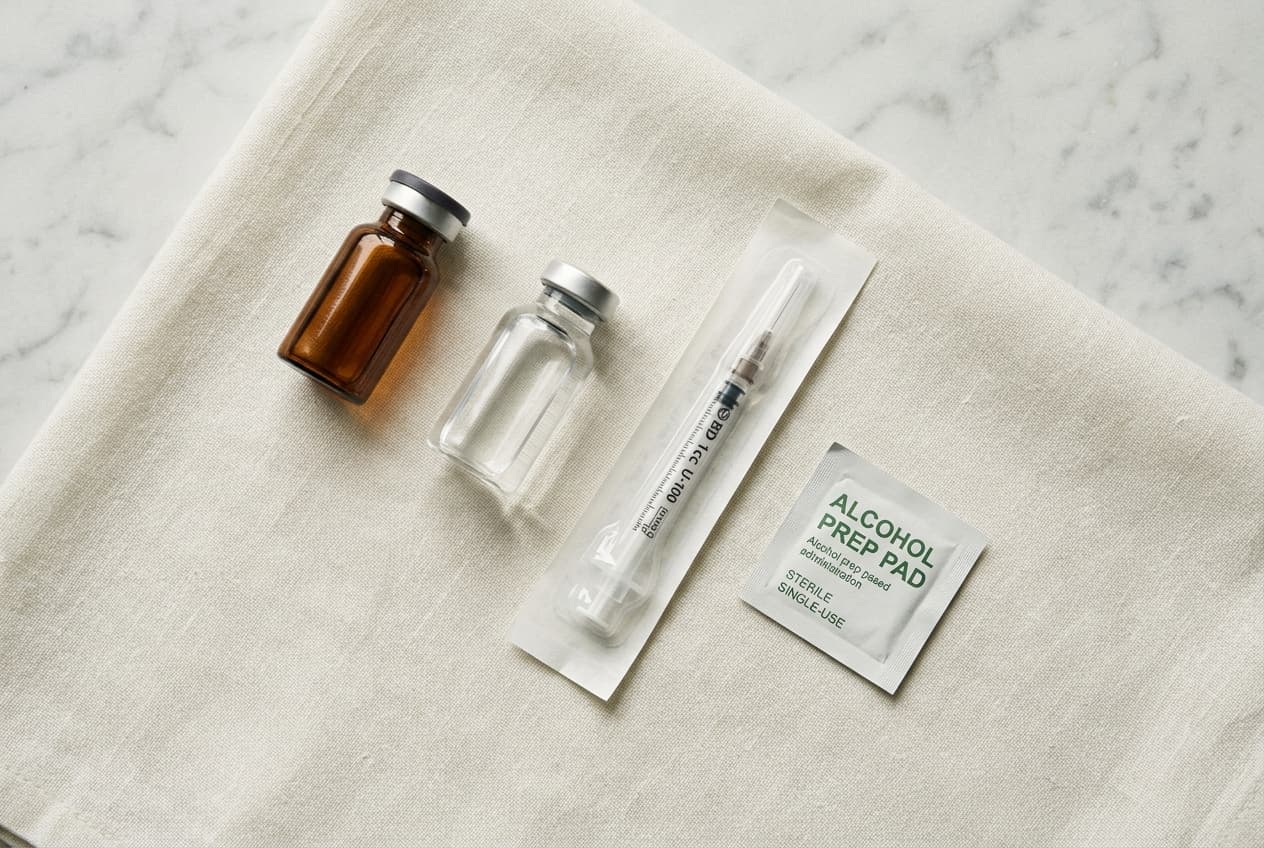
A 5 mg vial mixed with 2 ml bacteriostatic water gives 2.5 mg/ml. That makes a 100 mcg dose 0.04 ml — 4 units on a U-100 insulin syringe. A 200 mcg dose is 8 units. Subcutaneous abdomen, on an empty stomach, with the standard 30-minute food-free window on either side of the shot. Combine in the same syringe as Ipamorelin or another GHRP if you are running a stack; the peptides are compatible.
Open calculator pre-filledStorage after reconstitution
Refrigerate at 2–8 °C after reconstitution. Do not freeze. Light-protect. 28 days of stability at fridge temperature. The no-DAC version is short-acting but the molecule in BAC water is comparable to other modified GHRHs in shelf life.
Common mistakes
Using no-DAC for once-weekly convenience.
Better approach: If you want one shot a week, that is what DAC is for. No-DAC needs daily, often twice-daily dosing because the half-life is 30 minutes. Choose the version that matches your dosing pattern, not the other way around.
Running it solo and being disappointed.
Better approach: GHRH alone produces a real but modest pulse. Pair with Ipamorelin or another clean GHRP and the pulse roughly doubles. The combination is the design intent; solo use undersells what the peptide can do.
Eating into the post-injection window.
Better approach: Insulin blunts the GH pulse. 30 minutes clear on either side. People who 'feel nothing' from CJC are often the same people who inject five minutes before their oatmeal.
Pushing doses above 300 mcg per pulse.
Better approach: The dose-response on the GHS receptor saturates well before 300 mcg. Going higher does not produce a bigger pulse; it just uses up more peptide. Run multiple pulses (AM + pre-bed) instead of escalating a single pulse.
Real-world tips
- Pre-bed alone is the lightest viable protocol and the one most people should start with.
- Track sleep depth in the first two weeks; it is the most reliable read on whether the batch is potent.
- If you are running CJC + Ipamorelin, draw both into one syringe. No reason to take two needles for what one will do.
- Refrigerate the reconstituted vial. 3–4 weeks at fridge temperature with no meaningful potency loss.
- If the flushing is intense, you injected too fast. The peptide hits the bloodstream as a bolus when you push the plunger quickly.
When something else is the better tool
CJC-1295 with DAC
Use instead when: You want once-weekly dosing and are comfortable trading the pulsatile pattern for the convenience. DAC produces a continuous elevation; no-DAC produces discrete pulses. The trade-off is real — DAC desensitises receptors faster.
Sermorelin
Use instead when: You want a GHRH closer to the body's native version. Sermorelin is unmodified GRF(1-29); CJC-1295 is the same backbone with substitutions that stabilise it against rapid enzymatic breakdown. Sermorelin's pulse is shorter and gentler — which can be the right tool if minimal pharmacological intervention is the goal.
Tesamorelin
Use instead when: Visceral fat is the explicit target. Tesamorelin is a different GHRH analogue with a body of trial data specifically on abdominal-fat reduction — CJC-1295's evidence base is on pulse pharmacology, not body-composition endpoints.
- Why not just use the DAC version?
- DAC turns the pulse into a continuous bleed by binding albumin. That sounds convenient — and is — but the receptor downregulates faster under continuous stimulation than under pulses. No-DAC preserves the rhythm the pituitary evolved to work with.
- Do I need to stack it with Ipamorelin?
- No, but the synergy is what most users come for. Solo CJC-1295 produces a real pulse; CJC + GHRP roughly doubles the amplitude. If you want maximum signal per dose, run the stack.
- How is this different from Sermorelin?
- Same family, same backbone — Sermorelin is the first 29 amino acids of natural GHRH. CJC-1295 (no DAC) is Sermorelin with substitutions that resist enzymatic breakdown, giving it a longer half-life. The pharmacology is similar; the pulse is fuller.
- Best injection timing?
- Pre-bed on an empty stomach for the sleep-onset GH window. Add an AM fasted shot if you want a fuller daily exposure. Pre-workout dosing also works for performance-focused users.
- How long can I cycle?
- 12 weeks on, 4 weeks off is the standard rhythm. Continuous use beyond that produces receptor downregulation; the off-period restores responsiveness.