CJC-1295 / Ipamorelin
Also known as: CJC + Ipa · Mod-GRF + Ipamorelin · GHRH+GHRP stack
The workhorse GH-secretagogue stack: a GHRH analogue paired with a selective ghrelin agonist. GHRH plus GHRP produces more GH per pulse than either alone, with a side-effect profile most people find tolerable for indefinite use.
Overview
CJC-1295 (no DAC) tells the pituitary to release GH; Ipamorelin tells it to release more, through a different receptor. The two mechanisms multiply rather than add — the canonical small trials show roughly double the pulse amplitude versus either peptide solo. What people actually feel is sleep first, recovery second, body composition third. The cleanness comes from Ipamorelin's selectivity: unlike the older GHRPs, it does not bump cortisol or prolactin meaningfully, so the stack runs for months without the endocrine drift that bigger GHRPs produce.
Evidence quality
GHRH + GHRP synergy is well-documented in short-term human studies going back to the early 2000s — the pulse-amplification effect is real and replicated across multiple research groups. What is limited is long-term safety and body-recomposition outcome data. The 12-week protocols people run are an extrapolation from the acute-pulse pharmacology, not from a body-recomp RCT base. The mechanism is tight; the chronic-use evidence is thinner than the popularity suggests.
Benefits & timeline
Benefits
- Endogenous GH elevation without the metabolic side effects of exogenous HGH
- Sleep depth improves within the first week — the most reliable early signal
- Gradual body recomposition over 8–12 weeks; recovery between sessions shortens before the mirror changes
- Tolerability is good enough that most users stay on it longer than they originally planned
Timeline
Week 1
Sleep deepens. People wake less and dream more vividly.
Week 2–4
Recovery between training sessions shortens. Soreness clears faster.
Week 6–8
Subtle body composition shift, mostly visible at the waist.
Week 12
Plateau. Receptors begin to dial down sensitivity; cycle off to keep them responsive.
Off-cycle
Four weeks off refreshes receptor sensitivity. The next cycle works as well as the first.
Dosage protocols
Advanced
300 mcg
thrice daily, each
Beginner
100 mcg
once nightly, each
Each peptide 100 mcg, combined in same syringe.
Standard
200 mcg
twice daily, each
Titration & adjustment
No GI titration — but receptor desensitisation is the main concern. Start at 100 mcg of each peptide once nightly for 2 weeks. If subjective effects (sleep depth, recovery) hold, increase to 200 mcg of each, twice daily (AM fasted + pre-bed) for 4 weeks. Maximum is 300 mcg three times daily. Cycle off for 4 weeks every 12 weeks to refresh receptor sensitivity.
Injection timing
Pre-bed alone for sleep-focused users (single injection, ~30 minutes before lights-out). For more aggressive protocols: AM fasted + pre-bed. No carbs or protein in the 30 minutes around any injection. Pre-workout dosing is also effective for performance-focused users.
Side effects & contraindications

- mildFlushing or warmth in the face for a few minutes after injection. This is the Ipamorelin component — fades within 10 minutes.
- mildTingling or transient numbness, usually hands or face.
- mildMild hunger 30–60 minutes after the shot. Ipamorelin is a ghrelin agonist; the appetite signal is real but much milder than GHRP-6.
- moderateReceptor desensitisation if cycled too long. The GHS-R1a downregulates with continuous stimulation, which is why the 12-on / 4-off rule exists.
Contraindications
- Active cancer or recent cancer history — IGF-1 elevation is the mechanism you do not want to amplify
- Pregnancy or breastfeeding — no human safety data in either context
- Severe insulin resistance or poorly controlled diabetes
- Caution with concurrent corticosteroid use — the two signals work against each other on the GH/IGF axis
Reconstitution & injection
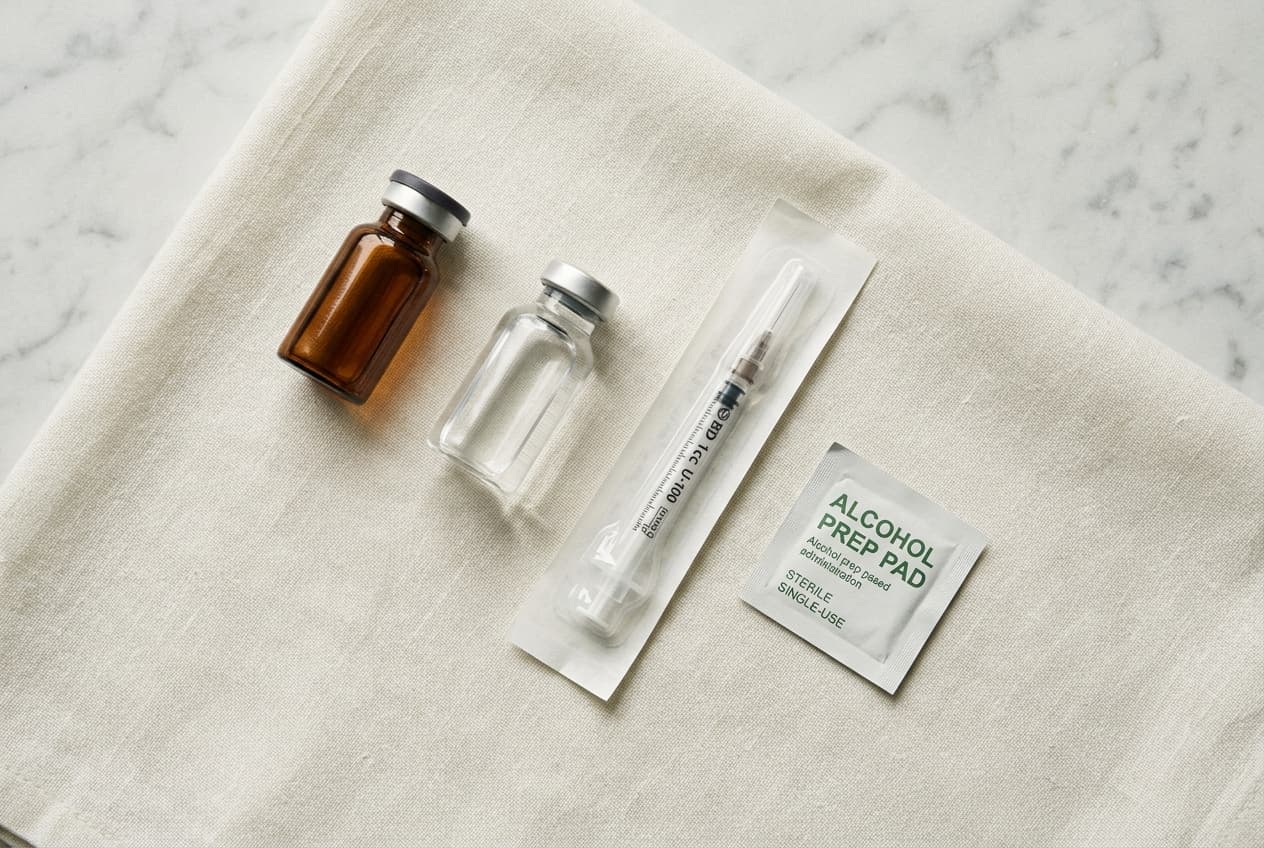
A 2 mg vial of each peptide reconstituted with 2 ml bacteriostatic water gives 1 mg/ml. A 100 mcg dose of each is 0.1 ml — 10 units on a U-100 insulin syringe. Both peptides can be drawn into the same syringe and injected together; they are chemically compatible and the convention is one shot, not two. Subcutaneous abdomen, on an empty stomach, with a 30-minute food-free window on either side of the injection.
Open calculator pre-filledStorage after reconstitution
Refrigerate the blended vial at 2–8 °C after reconstitution. Do not freeze. Light-protect. Stable for 28–30 days at fridge temperature in BAC water. CJC-1295 (no DAC) is the slightly less stable component of the blend — once the vial is past 4 weeks, drop it even if you have solution left. Solution should be clear and colourless throughout the dosing window.
Common mistakes
Eating right before or right after the shot.
Better approach: Insulin and amino acids both blunt the GH pulse. Keep a 30-minute window clear on either side. Water and black coffee are fine; everything else waits.
Running the stack continuously for 6+ months.
Better approach: The GHS-R1a downregulates with chronic stimulation. 12 weeks on, 4 weeks off keeps the receptor responsive and the second cycle as good as the first. Skipping the off-period is the most common reason users feel the stack 'stopped working'.
Splitting CJC and Ipa into separate syringes on separate sides.
Better approach: They mix in one syringe without issue. One needle, one site, less skin irritation. The pharmacokinetics are identical to two separate shots.
Picking the DAC version because it is cheaper per week.
Better approach: DAC produces a continuous GH bleed, not pulses. The synergy with Ipamorelin is a pulse-on-pulse effect — pair Ipamorelin with no-DAC CJC, not DAC CJC. If once-weekly dosing matters more than the synergy, use DAC alone.
Real-world tips
- Pre-bed dosing alone is enough for sleep and most general recovery goals. Add an AM fasted shot only if you have a specific body-recomp target.
- Track sleep quality (Oura, WHOOP, or a notebook). Week-1 sleep change is the most reliable early read on whether the batch is potent.
- Refrigerate after reconstitution. 3–4 weeks at fridge temperature is the practical window for a 2 mg vial dosed at 100 mcg twice daily.
- Inject into the abdomen, rotate sites. The volumes are small enough that lipoatrophy is rare, but rotation is still good hygiene.
- If the flushing is severe, you injected too fast. Slow the plunger over 5–10 seconds and it usually disappears.
When something else is the better tool
HGH (Somatropin)
Use instead when: You need a bigger pharmacological effect than secretagogues can produce — usually serious body recomposition on a deadline, or clinical GH deficiency. HGH wins on magnitude; the stack wins on safety and sustainability.
Ipamorelin alone
Use instead when: Sleep is the only goal and the cost or complexity of running two peptides is not worth it. Ipamorelin solo at pre-bed delivers most of the sleep benefit; the CJC component is what amplifies the body-composition signal.
Sermorelin
Use instead when: You want a gentler, older GHRH that aligns specifically with the natural overnight pulse. Sermorelin is closer to native GHRH in structure and half-life; CJC-1295 is more durable and produces a fuller pulse. For age-related GH decline without a body-recomp goal, Sermorelin is the lighter touch.
- Once daily or twice?
- Once pre-bed gets you most of the sleep benefit. Twice daily (AM fasted + pre-bed) adds the body-recomp signal. Three times daily is for users chasing maximum IGF-1 elevation and accepting the receptor-desensitisation risk that goes with it.
- Can I eat right after?
- Wait 30 minutes. Insulin from a meal blunts the GH pulse; the whole point of the shot is the pulse, so eating into it wastes the dose.
- Will it shut down my own GH?
- No — that is the point. Secretagogues stimulate the pituitary to release its own GH, so the axis stays active. This is the structural advantage over exogenous HGH, which suppresses endogenous production for the duration of the cycle.
- How long can I run it?
- 12 weeks is the standard cycle. Beyond that the GHS-R1a starts to dial down; 4 weeks off resets it. Some users run longer cycles by alternating doses (one week at 100 mcg, one week at 200 mcg), but the cleaner pattern is just to take the off-period.
- Why not just use HGH?
- HGH is bigger, more expensive, and the side-effect profile (fluid retention, joint aches, insulin resistance, glucose monitoring) is meaningfully heavier. The stack delivers most of the upside at maybe a tenth of the side-effect burden. It is the right tool when 'most of the benefit' is enough.