
GLOW Stack
Also known as: GLOW · TB + BPC + GHK-Cu
A pre-blended convenience vial containing TB-500, BPC-157 and GHK-Cu in one daily injection. Marketed as a recovery-plus-skin protocol.
Overview
GLOW is a commercial blend rather than a designed protocol — TB-500, BPC-157, and GHK-Cu mixed into a single lyophilised vial so users can run a single daily injection instead of three. The components have complementary stories on paper: TB-500 for systemic tissue repair, BPC-157 for local healing, GHK-Cu for skin and connective-tissue quality. The honest catch is that pre-blending costs you control. You can't titrate one component without titrating all three, and if a side effect emerges (the GHK-Cu flush, the TB-500 lethargy, the BPC-157 injection-site reaction) you have no way to identify which component is responsible without breaking the blend. The evidence base is the sum of the components' evidence bases — meaning preclinical-only for two of them, anecdotal-supportive for the third, and zero RCTs of the blend itself.
Evidence quality
No trials exist of the GLOW blend itself. Evidence is inherited from the three components: BPC-157 (preclinical-only, Sikiric group dominates the literature), TB-500 (preclinical-only, animal data plus anecdote), and GHK-Cu (preclinical and limited human cosmetic data, decent dermatology literature). The blend is a convenience preparation, not a trial-validated protocol. Treat the evidence as the floor of the three components, not as something stronger because they are combined.
Benefits & timeline
Benefits
- Convenience — one daily injection instead of three separate vials and three injection schedules
- Subjectively reported skin and hair quality improvements over a 6–8 week cycle, attributed to the GHK-Cu component
- Recovery effects between training sessions, attributed to the TB-500 and BPC-157 components
- Lower per-vial cost than buying the three peptides separately, in most grey-market price brackets
Timeline
Week 1–2
Mild lethargy possible (TB-500 component). Sleep often improves slightly. Skin changes not yet visible.
Week 3–4
Recovery between sessions starts to feel better. Skin texture changes begin in users predisposed to respond.
Week 4–6
Visible skin and hair changes — softer texture, mild glow effect attributed to GHK-Cu. Recovery benefits steady.
Week 8
Plateau. Cycle off to reassess. Continuing past 8 weeks rarely adds benefit and increases cumulative GHK-Cu exposure unnecessarily.
Off-cycle
4 weeks off. Skin changes from GHK-Cu often persist; recovery effects from TB-500/BPC-157 fade more quickly.
Dosage protocols
Advanced
2 mg
twice daily (blended)
Beginner
1 mg
once daily (blended)
Standard
1 mg
twice daily (blended)
Titration & adjustment
No individual titration — start at 1 ml of the reconstituted blend once daily for 2 weeks, then 1 ml twice daily for 4–6 weeks if recovery and skin quality improve. Off-cycle for 4 weeks every 8 weeks.
Injection timing
Once daily, subcutaneous, abdomen or thigh. Evening dosing can support sleep depth from the BPC/TB components. Rotate injection sites to avoid local irritation from the copper component.
Side effects & contraindications

- mildLocalised injection-site reaction — slight redness or bump, often more pronounced than single-component injections because of the volume.
- mildTemporary blue-tint discoloration at the injection site from the GHK-Cu copper complex.
- mildLethargy in the first week — typical TB-500 effect.
- moderateNo formal safety data on the blend itself. Each component carries its own caveats; pre-blending stacks them without monitoring.
Contraindications
- Active cancer — TB-500 and BPC-157 angiogenic effects rule it out, same logic as the individual peptides
- Pregnancy or breastfeeding
- Wilson's disease or any copper-accumulation disorder, because of the GHK-Cu component
- Known hypersensitivity to any of the three components — you can't unmix them once mixed
Reconstitution & injection
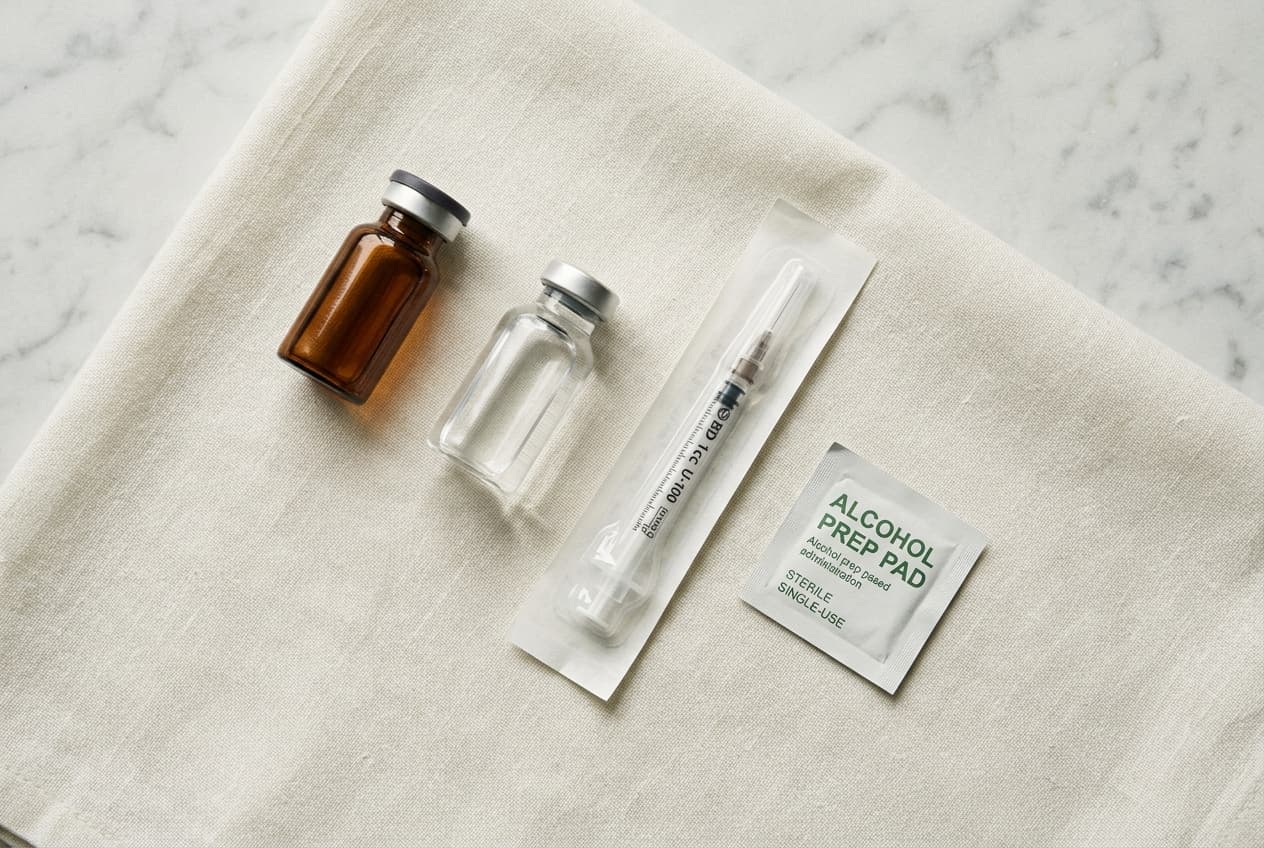
A 'GLOW' vial typically contains TB-500 10 mg + BPC-157 10 mg + GHK-Cu 50 mg lyophilised together. Reconstitute with 5 ml bacteriostatic water for a 14 mg/ml total peptide concentration in a fixed ratio. A 0.1 ml dose draws 10 units on a U-100 insulin syringe and delivers roughly 200 mcg TB-500 + 200 mcg BPC-157 + 1 mg GHK-Cu per shot. Subcutaneous, abdomen or thigh. Rotate sites to avoid the localised blue tint accumulating in one spot. Refrigerate; use within 30 days.
Open calculator pre-filledStorage after reconstitution
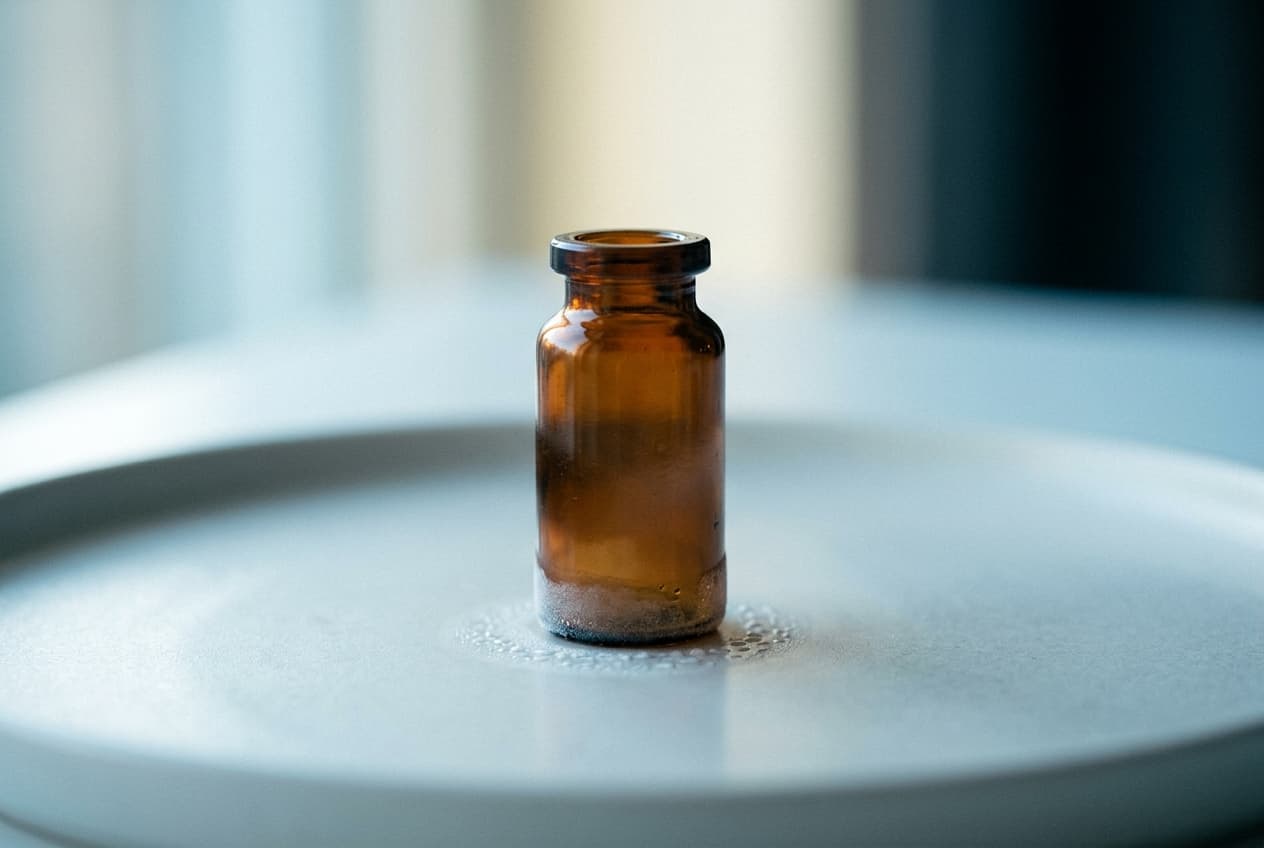
Refrigerate at 2–8 °C after reconstitution. Do not freeze. Light-protected. The blend (GHK-Cu + healing peptides) is stable for 21–28 days at fridge temperature. The copper component will deepen in colour over the dosing window — this is normal; the blue/teal tint becomes more pronounced, not a sign of degradation. Discard for cloudiness or precipitate, not for colour deepening.
Common mistakes
Picking GLOW because it sounds 'comprehensive.'
Better approach: If you have a specific goal (an injury, a skin issue, a recovery question), buying the three peptides separately and dosing each at the right dose for the right target is more effective. GLOW is the convenience pick, not the optimisation pick. If you don't know which of the three you actually need, run the targeted single-peptide protocol that matches your goal.
Trying to dose-titrate the components independently within a blended vial.
Better approach: You can't. The ratio is fixed at the vial. If GHK-Cu side effects are limiting you (flush, blue-tint accumulation), you have to lower the whole blend dose, which also lowers the TB-500 and BPC-157 you wanted. Switch to separate vials if titration matters.
Running GLOW back-to-back with no off-cycle.
Better approach: Each component has its own off-cycle logic, and the cumulative GHK-Cu exposure in particular is best limited. Cycle 6–8 weeks on, at least 4 weeks off, and use the off period to read whether the gains hold.
Co-locating injection sites every day.
Better approach: The GHK-Cu copper complex deposits a faint blue tint locally that takes weeks to clear. Rotating sites avoids the cosmetically obvious accumulation in one quadrant of the abdomen.
Real-world tips
- If you want to know which component is doing the work for you, run GLOW for one cycle, then run BPC-157 alone for the next cycle and compare. The two-cycle test is cheap and clarifies a lot.
- Inject in the evening if the TB-500 lethargy is noticeable during the day — the first-week fatigue tends to overlap with normal evening fatigue and is less disruptive.
- Rotate injection sites across the abdomen in a four-quadrant pattern. Keep notes on your phone of which quadrant you used; the blue-tint accumulation is the visible cue if you forget.
- Reconstituted blends degrade slightly faster than single peptides because three different molecules in solution interact. Use within 30 days at fridge temperature, not the longer windows some single peptides tolerate.
- If you're trying to fix a specific injury, GLOW is not the most efficient tool. Use the single-peptide protocol matched to your goal and save GLOW for the maintenance or aesthetic phase.
When something else is the better tool
BPC-157 + TB-500 + GHK-Cu in separate vials
Use instead when: You want titration control, want to identify which component is responsible for an effect or side effect, or want to optimise the dose of each. The separate-vial protocol is logistically harder but pharmacologically cleaner.
Single-peptide protocol matched to your goal
Use instead when: Your goal is specific — chronic Achilles, post-surgical recovery, skin maintenance. Pick the component that targets it (BPC-157 local, TB-500 systemic, GHK-Cu cosmetic) and dose it properly rather than running a diluted blend.
KLOW Stack
Use instead when: You want the same convenience but with an added anti-inflammatory component (KPV) for users with chronic inflammation or gut issues. KLOW is GLOW + KPV — same trade-offs around blend-vial control, with broader effect.
- What's the active dose per shot?
- A typical 0.1 ml dose from the standard blend delivers roughly 200 mcg BPC-157, 200 mcg TB-500, and 1 mg GHK-Cu. The BPC and TB-500 doses are lower than the standard single-peptide protocols (BPC-157 typically 250–500 mcg, TB-500 typically 2–5 mg per shot), so don't expect injury-specific outcomes to match a dedicated protocol.
- Can I add HGH or peptide GH-secretagogues to GLOW?
- Mechanistically there's no conflict; some users do. Watch the total injection burden (GLOW is already one daily shot) and remember that adding GH-axis compounds adds its own cycle logic.
- Why the temporary blue tint?
- GHK-Cu is a copper-complexed peptide. The copper colour shows at the injection site for a few days before the body clears it. Rotating sites prevents accumulation in one area.
- Is this safer than the individual components?
- No — it's the same risk profile, summed. Pre-blending doesn't add safety; it just removes your ability to identify and adjust which component is causing a problem.
- Why is it called GLOW?
- Marketing. The skin-quality story from GHK-Cu was the framing the original blend was sold under. It's not a clinical name and there's no trial referenced under that label.