HCG
Also known as: Human Chorionic Gonadotropin
Human chorionic gonadotropin — a placental hormone that mimics LH and tells the testes to keep making testosterone and sperm. The most clinically established HPG-axis tool in this catalogue.
Overview
HCG is the workhorse of the testicular-stimulation toolkit. Structurally it's similar enough to luteinising hormone that it binds the same Leydig-cell receptor, which means a small twice-weekly dose can maintain intratesticular testosterone and testicular volume in men on TRT, or kick the axis back into gear after a steroid cycle. It is FDA-approved for male hypogonadism and for stimulating ovulation in women, which is a notable distinction in a field full of off-label peptides — the regulatory data exists and the prescribing playbook is well-worn. The dose response is steep at the bottom (250 IU twice weekly is enough to preserve testicular volume on TRT) and shallow at the top (going from 1000 IU to 2000 IU buys mostly more estrogen, not more testosterone).
Evidence quality
HCG is FDA-approved for male hypogonadism and ovulation induction, with decades of clinical use and a deep literature on dosing, fertility outcomes, and TRT-adjunct protocols. The 2013 review (Coviello et al. and others) consolidated the use case for HCG monotherapy and combined HCG+testosterone protocols. This is one of the few entries in this catalogue where the regulatory framework and the off-label community use largely overlap.
Benefits & timeline
Benefits
- Maintains testicular volume and intratesticular testosterone in men on TRT, which keeps spermatogenesis viable
- Restarts the HPG axis after anabolic-steroid suppression (post-cycle therapy) faster than waiting it out
- Approved for primary and secondary male hypogonadism — the indication is on-label, not improvised
- Often improves libido and morning erections in users whose TRT alone left those flat
Timeline
Week 1–2
Most users feel a modest libido and morning-erection improvement; testicular volume starts returning if it had shrunk.
Week 4
Testicular volume largely restored on a 250–500 IU twice-weekly protocol. Estrogen may begin to rise — check labs.
Week 6–8
Mood and energy stabilise. If labs show E2 climbing past comfort, dial the dose down before adding an aromatase inhibitor.
Week 12
Steady state on a TRT-adjunct protocol. For PCT users, this is when LH/FSH/total T labs tell you whether the axis is restarting on its own yet.
Off-cycle
On TRT, HCG is typically run continuously rather than cycled. For PCT, 4 weeks off lets you read the recovered baseline.
Dosage protocols
Advanced
1000 iu
twice weekly
Post-cycle therapy or testicular volume maintenance on TRT.
Beginner
250 iu
twice weekly
Standard
500 iu
twice weekly
Titration & adjustment
On TRT for testicular volume maintenance: 250 IU twice weekly is the standard starting dose. Increase to 500 IU twice weekly if testicular volume does not return after 4 weeks. For post-cycle therapy: 1000 IU twice weekly for 4–6 weeks. Beyond 1000 IU per dose, estrogen elevation becomes the limiting factor — pair with an aromatase inhibitor only if labs justify it.
Injection timing

Twice weekly, fixed days (e.g. Monday and Thursday). Time of day does not matter. Many users co-time with their testosterone injection to minimise jab days.
Side effects & contraindications

- mildMild injection-site soreness; the volume is small (250–500 IU is a fraction of an insulin syringe).
- mildAcne, oily skin, and mood changes — same as elevated testosterone in general.
- moderateElevated estradiol from increased Leydig-cell activity. Doses above ~500 IU twice weekly are where this becomes the dose-limiting variable. Don't add an AI prophylactically; treat what labs confirm.
- moderateGynecomastia if E2 is left unmanaged at higher doses. Reversible early, harder once glandular tissue has built.
- severeRare ovarian hyperstimulation syndrome in women being treated for infertility — clinical setting only.
Contraindications
- Hormone-sensitive cancers, particularly prostate carcinoma — stimulating gonadal steroid output is the opposite of what you want
- Active or untreated thromboembolic disease
- Precocious puberty in adolescents (a recognised pediatric contraindication)
- Pregnancy — different conversation if the goal is fertility under clinical supervision, but self-administered HCG is not appropriate during pregnancy
Reconstitution & injection
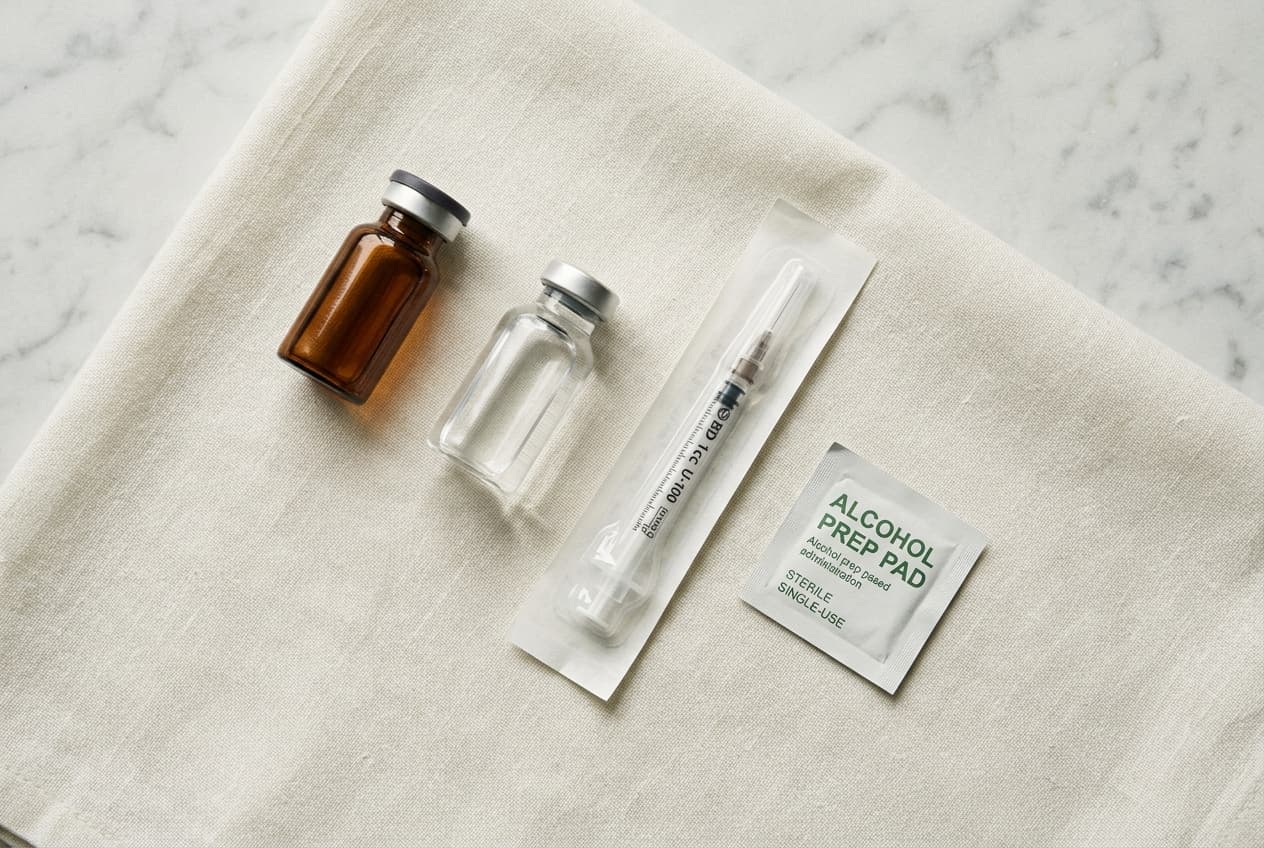
HCG vials are sold as lyophilised powder, usually 5000 IU per vial. Reconstitute with 5 ml bacteriostatic water for 1000 IU per ml — that means a 250 IU dose is 0.25 ml, which is 25 units on a U-100 insulin syringe; a 500 IU dose is 50 units. Subcutaneous into abdomen or thigh; intramuscular works but offers no advantage. Refrigerate after reconstitution and use within 30 days. The peptide is fragile — don't shake the vial, swirl it.
Open calculator pre-filledStorage after reconstitution
Refrigerate at 2–8 °C immediately after reconstitution. Do not freeze — freezing destroys the glycoprotein structure. Light-protected. HCG is thermolabile; reconstituted potency is reliable for 30 days at fridge temperature, with measurable drop-off thereafter. Travel: never in checked luggage, never above 25 °C for more than a few hours. The clear, colourless solution should not develop any haze. Cold injection is uncomfortable — warm the vial briefly in your hand before drawing.
Common mistakes
Stacking HCG with TRT without ever checking estradiol.
Better approach: Adding HCG to a stable TRT protocol can push E2 up noticeably because intratesticular aromatase activity is restored. Get an E2 (sensitive assay) at 4 and 8 weeks after starting HCG. If it climbs uncomfortably, lower the HCG dose before reaching for an AI.
Running 1000 IU+ doses daily during PCT thinking more is faster.
Better approach: Above ~500 IU twice weekly, you're mostly buying more estrogen and a slower recovery of the upstream axis, because high HCG itself can suppress endogenous LH. The PCT goal is to keep the testes responsive while LH comes back, not to flood them. 1000 IU twice weekly for 4–6 weeks is the established ceiling for PCT.
Using HCG to 'restart' an axis that's actually pituitary-suppressed.
Better approach: HCG bypasses the pituitary — it tells the testes to work but doesn't restart LH/FSH output. If the goal is full axis recovery, pair with clomiphene/enclomiphene or use gonadorelin upstream. HCG alone is a Leydig-cell stimulant, not a pituitary one.
Subcutaneous versus intramuscular religious wars.
Better approach: Both routes work. Subcut is more convenient and less painful with small volumes. The pharmacokinetic difference is trivial compared to dose and frequency. Pick subcut unless you have a reason.
Real-world tips
- Co-time HCG injections with your testosterone injection day to minimise jab count. There's no pharmacological reason to spread them out.
- Reconstitute with bacteriostatic water, not sterile water, if you want the vial to last more than 24 hours. The benzyl alcohol matters.
- Keep the reconstituted vial upright in the fridge door, not in the back — temperature swings from opening and closing the door are easier on the peptide than freezing-zone proximity.
- If testicular volume has been shrunk for years on TRT-only, expect 6–8 weeks of HCG before it fully returns. The Leydig cells are sluggish but not dead.
- Labs to order on an HCG protocol: total T, free T, E2 (sensitive/LC-MS), SHBG, and a CBC. Add LH/FSH only if you're running PCT, not on chronic TRT-adjunct dosing.
When something else is the better tool
Gonadorelin
Use instead when: You want to restart the entire axis at the pituitary level, not just the testes. Gonadorelin is the upstream tool; HCG is the downstream one. Gonadorelin's pulsatile dosing burden is the trade-off.
Clomiphene or enclomiphene
Use instead when: Oral preference, lower cost, and a goal of restoring endogenous LH/FSH rather than supplying an LH-mimic. SERMs are the right pick for younger men trying to preserve fertility without ongoing injections.
HMG
Use instead when: Spermatogenesis is the primary goal and HCG alone isn't moving sperm parameters. HMG supplies the FSH-like signal that HCG doesn't.
- Will HCG alone restore fertility?
- Often, yes — but it depends. HCG supplies the LH signal that maintains intratesticular testosterone, which is the dominant driver of spermatogenesis. For many men coming off TRT, HCG alone is enough to recover sperm counts over 6–12 months. If counts stay suppressed, that's when you add HMG for the FSH component.
- How long until testicular volume returns?
- On a 250–500 IU twice-weekly protocol, most users see noticeable size return within 2–4 weeks and full restoration by 6–8 weeks. Long-suppressed testes take longer than recently-suppressed ones.
- Is HCG appropriate for women?
- Yes, in clinical fertility settings — it's used to trigger ovulation in IVF and timed-intercourse protocols. That's a different prescribing context with monitoring and shouldn't be self-administered.
- Why does HCG sometimes cause estrogen spikes?
- Reactivated Leydig cells produce testosterone, and the intratesticular aromatase enzyme converts a chunk of it to estradiol directly inside the testis. The serum E2 you measure reflects both peripheral conversion and this intratesticular contribution. Higher HCG doses, more aromatase activity, higher E2.
- Can I run HCG long-term on TRT?
- Yes — continuous low-dose HCG (250 IU twice weekly) alongside TRT is the standard protocol for men who want to preserve testicular function. Off-cycle is not necessary the way it is with most peptides here, because you're maintaining a system, not pushing it.