KLOW Stack
Also known as: KLOW · TB + BPC + GHK + KPV
GLOW plus KPV — the same TB-500 + BPC-157 + GHK-Cu blend with an added anti-inflammatory tripeptide. Marketed at users with gut or chronic-inflammation overlap.
Overview
KLOW is GLOW with KPV added, and the rationale is straightforward: if you already wanted the recovery-plus-skin convenience of GLOW and you also carry chronic inflammation (gut issues, autoimmune flares, persistent injury inflammation), adding KPV gives you an anti-inflammatory layer in the same daily shot. KPV is the tail tripeptide of α-MSH, with a credible immune-modulatory literature, especially in IBD models. The same caveats as GLOW apply doubled: four peptides in a fixed-ratio vial means no titration of individual components, and the evidence for the blend is the floor of its components, none of which has a Phase 3 trial behind it. KLOW is a convenience preparation for users who already know they want all four. If you don't know whether you need the KPV, you probably don't yet.
Evidence quality
No trials exist of the KLOW blend. Evidence is the floor of its four components: BPC-157 (preclinical-only), TB-500 (preclinical-only), GHK-Cu (preclinical plus limited cosmetic-trial data), and KPV (preclinical-only with the 2009 review covering the IBD-relevant immune-modulation literature). The blend is a convenience preparation, not a trial-validated protocol. The KPV anti-inflammatory case is mechanistically reasonable but has not been validated in a human RCT of this blend.
Benefits & timeline
Benefits
- Anti-inflammatory effect added to the recovery and skin profile, attributed to the KPV component
- Anecdotally useful in IBS and IBD support, where KPV's gut-immune effects layer onto BPC-157's gut-healing role
- Single daily injection covering recovery, skin, and inflammation in one routine
- Slightly broader-spectrum than GLOW for users with autoimmune or chronic-inflammation flares
Timeline
Week 1–2
Inflammatory markers and recovery start to shift. KPV's effect on gut symptoms is often the first thing users notice if that's their target.
Week 3–4
Recovery benefits steady. Skin texture changes begin.
Week 4–6
Visible skin changes from GHK-Cu, gut-symptom reduction from KPV + BPC-157, recovery improvements from TB-500.
Week 8
Plateau. Cycle off and reassess.
Off-cycle
4 weeks off. The KPV anti-inflammatory effect often fades faster than the GHK-Cu skin effect, so symptoms can return before the cosmetic gains do.
Dosage protocols
Advanced
2 mg
twice daily (blended)
Beginner
1 mg
once daily (blended)
Standard
1 mg
twice daily (blended)
Titration & adjustment
Same titration as GLOW: 1 ml daily for 2 weeks, then 1 ml twice daily. Because KPV adds an anti-inflammatory component, this stack is well suited to users with chronic inflammation or gut issues — keep doses on the lower end during flares.
Injection timing

Same as GLOW — once daily, evening, rotate sites. The added KPV is best dosed away from heavy meals so it does not get diluted with high gastric activity (less relevant for subcut, but matters if you switch to oral KPV capsules).
Side effects & contraindications

- mildInjection-site irritation, often more noticeable than single-component peptides because of the volume.
- mildBrief flushing or warmth from the KPV component within minutes of injection, fading inside an hour.
- mildTemporary blue tint at the injection site from GHK-Cu.
- mildLethargy in the first week from the TB-500 component.
- moderateNo formal safety data on the blend. Each component has its own caveats; the four-way blend has zero trials of its own.
Contraindications
- Active cancer — same angiogenesis logic as TB-500 and BPC-157
- Pregnancy or breastfeeding
- Wilson's disease or copper-accumulation disorders, due to GHK-Cu
- Severe immunosuppression where dampening immune signalling further is the wrong direction
- Known hypersensitivity to any component — and there are now four to consider
Reconstitution & injection
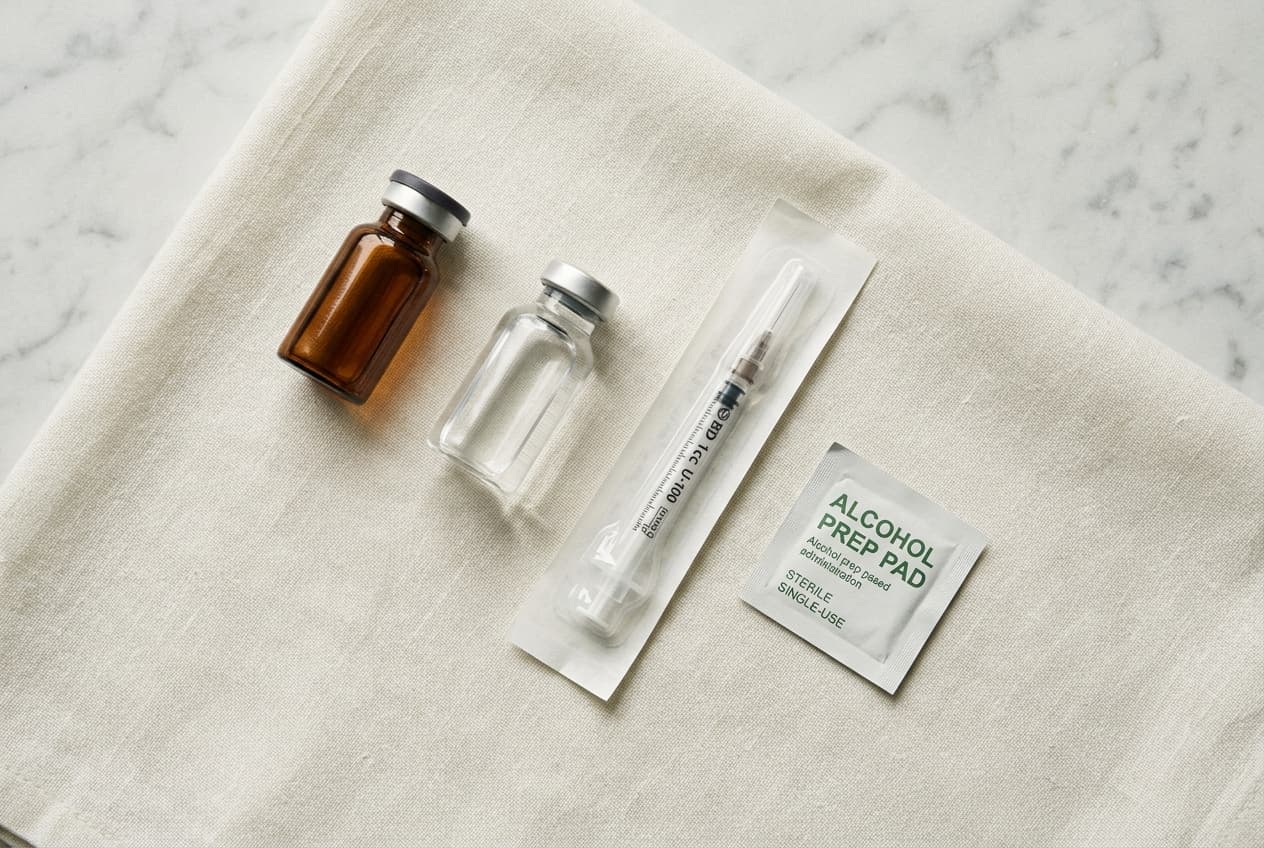
A 'KLOW' vial typically contains TB-500 10 mg + BPC-157 10 mg + GHK-Cu 50 mg + KPV 10 mg lyophilised together. Reconstitute with 5 ml bacteriostatic water; a 0.1 ml dose draws 10 units on a U-100 insulin syringe and delivers roughly 200 mcg of each component plus 1 mg GHK-Cu. Subcutaneous into abdomen or thigh; rotate sites to manage the blue-tint accumulation. Refrigerate; use within 30 days. The added KPV doesn't change the storage envelope materially.
Open calculator pre-filledStorage after reconstitution
Refrigerate at 2–8 °C after reconstitution. Do not freeze. Light-protected. 14–21 days of stability at fridge temperature — the BPC-157 component is the weakest-link stability factor. Mix to match your dosing cadence; do not stretch a vial past 3 weeks.
Common mistakes
Picking KLOW over GLOW 'just in case' you might want the anti-inflammatory effect.
Better approach: If you don't have chronic inflammation, gut issues, or autoimmune symptoms, the KPV adds nothing useful — you're paying for and dosing a component you don't need. GLOW is the simpler choice. KLOW is for users who already know they want the inflammatory layer.
Using KLOW as an IBD-specific protocol when targeted dosing would be more honest.
Better approach: If gut inflammation is the primary problem, BPC-157 oral capsules plus KPV oral capsules at properly titrated doses is a stronger protocol than the diluted KLOW blend delivered subcutaneously. KLOW is a convenience tool, not an IBD specialist.
Long cycles based on the 'broader-spectrum' framing.
Better approach: Broader spectrum doesn't mean safer for long cycles. The GHK-Cu cumulative copper exposure and the four-component long-term safety question both argue for 6–8 week cycles with proper off-time, not continuous dosing.
Stacking with strong immunosuppressants without medical input.
Better approach: KPV's immune-modulatory effects layered onto active immunosuppressive therapy is a conversation for a specialist, not a self-administered call. Most users on biologics or systemic immunosuppression should not add KLOW without clinical clearance.
Real-world tips
- If the gut-inflammation use case is the primary draw, run BPC-157 + KPV as a two-peptide protocol first and see whether you actually benefit from the TB-500/GHK-Cu in KLOW. Often you don't.
- Track inflammatory markers if you have them available — CRP, fecal calprotectin if relevant, or simple symptom scores. Subjective inflammation drifts; an objective marker tells you whether KLOW is doing what you hoped.
- Rotate injection sites across at least four abdominal quadrants. The combined volume and the GHK-Cu copper deposition make site-rotation more important here than for single peptides.
- Keep doses on the lower end during active inflammatory flares — the immune-modulatory effect can be uncomfortable to navigate if dosed aggressively into a flare.
- Pair with the boring inflammation interventions — sleep, gut-friendly diet, identified trigger avoidance. The peptide is an adjunct, not a substitute.
When something else is the better tool
GLOW Stack
Use instead when: You want recovery and skin benefits but don't have a specific inflammatory or gut-symptom target. Same convenience, one fewer component to manage.
BPC-157 + KPV in separate vials
Use instead when: Gut healing or autoimmune support is the primary goal. The two peptides at proper individual doses (BPC-157 500 mcg, KPV 250–500 mcg) typically outperform the diluted blend version. Oral capsules work for both in gut-targeted contexts.
Standard anti-inflammatory pathway management
Use instead when: You haven't yet addressed obvious triggers — known food intolerances, sleep deprivation, alcohol load, untreated dental or sinus inflammation. A peptide blend is not the first move when the trigger is visible and ignored.
- GLOW or KLOW?
- KLOW for users who already carry chronic inflammation, gut issues, or autoimmune symptoms and want the KPV layer in the same shot. GLOW for users whose targets are recovery and skin alone. If you don't know which you need, you probably want GLOW.
- Can I run KLOW long-term?
- Not recommended. Cycle 6–8 weeks on, at least 4 weeks off. The cumulative GHK-Cu copper exposure and the four-component long-term safety question both argue against open-ended dosing.
- Why add KPV to GLOW?
- KPV is the tail tripeptide of α-MSH with a decent preclinical literature on immune modulation, particularly in IBD models. The rationale is layering an anti-inflammatory effect onto the recovery-plus-skin blend for users where chronic inflammation is part of the picture.
- Is the dose of each component still therapeutic in the blend?
- It depends on what you're measuring. A 0.1 ml dose delivers roughly 200 mcg of each component plus 1 mg GHK-Cu — lower than the standard single-peptide doses for BPC-157 (250–500 mcg), TB-500 (2–5 mg), and KPV (250–500 mcg). Expect milder per-component effects than dedicated single-peptide protocols.
- Does it help with autoimmune flares?
- Anecdotally some users report a calming effect during flares, attributed to the KPV component. There is no controlled trial of KLOW in autoimmune disease. If autoimmune disease is the primary target, this should be a conversation with a treating clinician, not a self-administered protocol.