
LL-37
Also known as: LL-37 · Cathelicidin
The body's main cathelicidin — a broad-spectrum antimicrobial peptide. Strong in vitro, useful in topical research, almost nothing settled about systemic use.
Overview
LL-37 is the active fragment of human cathelicidin, the only cathelicidin our species makes. It's a 37-amino-acid antimicrobial peptide produced by neutrophils and epithelial cells as part of the innate immune response, and it punches holes in bacterial membranes the way detergents punch holes in oily films. The in vitro story is impressive: broad activity against gram-positive and gram-negative bacteria, several fungi, and some viruses, plus a role in wound healing and biofilm disruption. The clinical story is much smaller. There are early human trials of synthetic LL-37 analogues for chronic wounds and venous leg ulcers, and a few topical formulations have made it to small Phase 2 work. Systemic injection in humans is essentially untested at the doses people are using grey-market, and the immune-modulation effects raise as many questions as they answer.
Evidence quality
Extensive in vitro and animal data dating back to the 1990s. The Gudmundsson and Agerberth groups in Sweden have driven much of the foundational work. Human trials exist for topical LL-37 analogues in chronic wounds and venous leg ulcers (early Phase 2). Systemic injectable LL-37 in healthy users has essentially no formal evidence base.
Benefits & timeline
Benefits
- Broad-spectrum antimicrobial activity in vitro — bacteria, fungi, some viruses, including biofilm-forming organisms
- Wound healing benefit in early topical trials for chronic ulcers
- Immune modulation, both anti-inflammatory and pro-inflammatory depending on context — interesting, but not necessarily what you want unsupervised
- Useful research interest as a template for next-generation antimicrobials, where antibiotic resistance is squeezing the conventional pipeline
Timeline
Week 1–2
Subjective improvement in chronic infection symptoms in users who respond; nothing for non-responders.
Week 4
Inflammatory and infection-marker trends are usually clear by now.
Week 6–8
End of typical cycle — assess and decide whether continuation is justified.
Off-cycle
At least 4 weeks off before any repeat course. Continuous dosing may dysregulate immune signalling in ways the literature hasn't characterised.
Dosage protocols

Advanced
500 mcg
three times weekly
Beginner
100 mcg
three times weekly
Standard
300 mcg
three times weekly
Titration & adjustment
Start at 100 mcg subcutaneously three times weekly. After 2 weeks escalate to 300 mcg three times weekly. Maximum 500 mcg three times weekly. Because immune signalling can be perturbed long-term, never cycle longer than 8 weeks and always pause for at least 4 weeks before repeating.
Injection timing

Three times weekly, time of day flexible. Subcutaneous abdomen or thigh, rotate sites because injection-site irritation is the most common side effect.
Side effects & contraindications

- moderateInjection-site irritation and flushing — the most consistent and dose-related side effect.
- moderateChronic dosing may perturb immune signalling, including biasing T-cell responses in directions the user can't monitor without specialist labs.
- moderateLimited long-term human safety data at injectable doses. The endogenous form exists in your body; the exogenous form at supplemental concentrations isn't a comparable exposure.
- mildHistamine release at the injection site in sensitive users — itchy weal, resolves within hours.
Contraindications
- Pregnancy
- Active autoimmune disease — the immune-modulation effects could destabilise an already-misfiring immune system
- Active cancer — LL-37 has been reported to promote tumour growth in some preclinical contexts via angiogenesis and proliferation pathways
- Concurrent biologic immunosuppression — interaction is undefined and the mechanisms overlap
Reconstitution & injection
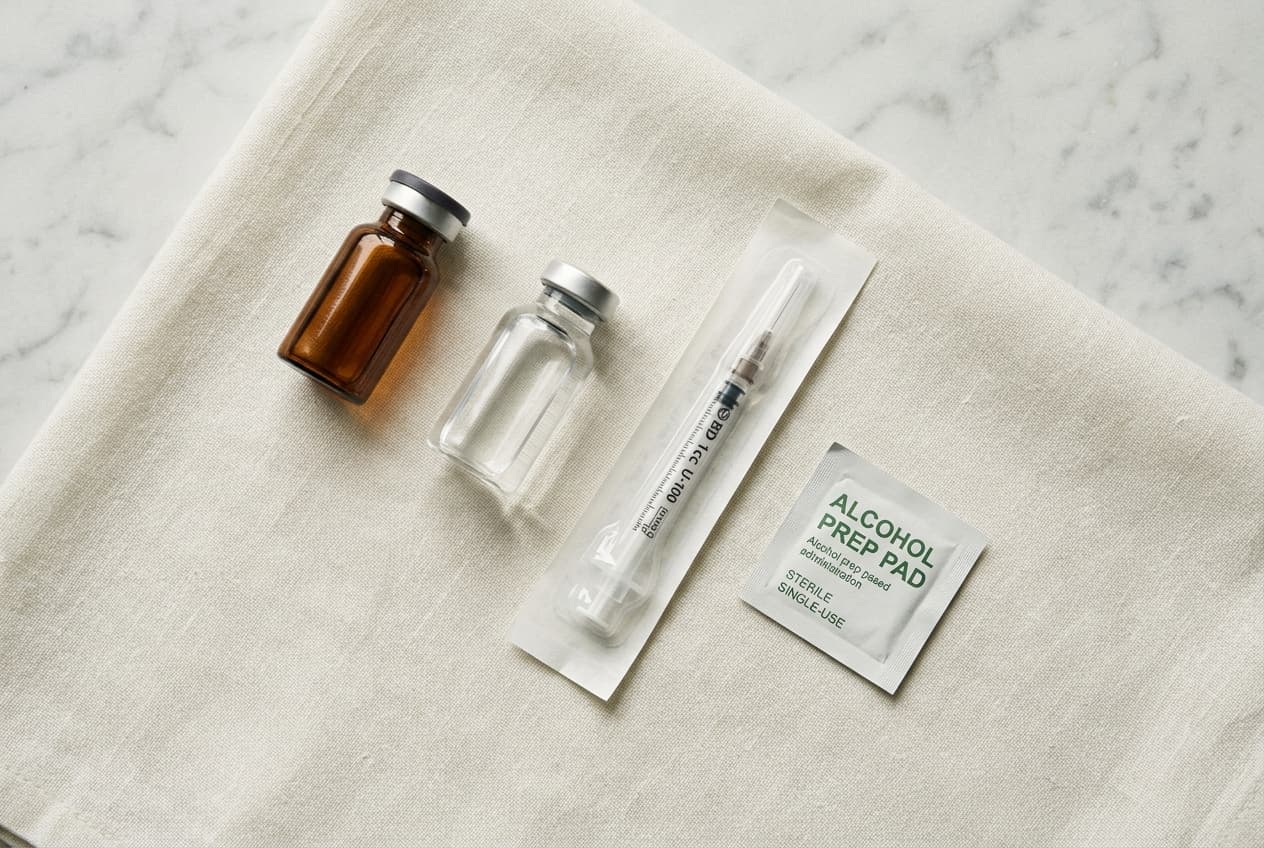
A 5 mg vial reconstituted with 2 ml bacteriostatic water gives 2.5 mg/ml. A 300 mcg dose is 0.12 ml, which is 12 units on a U-100 insulin syringe. Subcutaneous in the abdomen or thigh, three times weekly. Rotate sites because injection-site flushing is the most common reason people stop. Topical formulations exist for wound and skin protocols at 0.5–1% in a clean carrier — for chronic ulcers, apply once daily under a clean dressing.
Open calculator pre-filledStorage after reconstitution

Refrigerate at 2–8 °C after reconstitution. Do not freeze. Light-protected. LL-37 is a longer cathelicidin peptide and less stable than smaller peptides in solution — realistic fridge window is 14–21 days. Because LL-37 is also injection-site-irritating, users typically run shorter cycles, so a single mix can match a dosing block.
Common mistakes
Using it as a general antibiotic substitute.
Better approach: It isn't an antibiotic in the way you'd substitute for amoxicillin. The in vitro activity is real; the in vivo dose-response, tissue penetration, and clinical reliability of injected LL-37 are not characterised. Treat real infections with real antibiotics; use LL-37 as an adjunct for chronic, biofilm-driven contexts where conventional treatment has stalled.
Running it continuously.
Better approach: The immune-modulation profile is biphasic and dose-dependent. Continuous high exposure can shift things in directions you can't see without specialist labs. Cycle 6–8 weeks maximum, with at least 4 weeks off between courses.
Ignoring the cancer caveat.
Better approach: Preclinical data shows LL-37 can promote tumour growth in some contexts via angiogenesis. If there's any active or recent cancer history, the risk-benefit math doesn't work; pick a different tool.
Buying generic 'antimicrobial peptide' powder.
Better approach: Purity matters enormously with a peptide this long. Mis-folded or truncated material may have very different activity than full-length LL-37. Buy from a source with a published certificate of analysis, or don't bother.
Real-world tips
- Rotate injection sites systematically — left abdomen, right abdomen, left thigh, right thigh. Injection-site reactions are the most common cause of dropouts.
- Inject slowly. Faster injection produces more histamine release and a bigger local weal.
- For chronic wound use, the topical formulation has the strongest evidence. Don't reach for the injection if a topical application can reach the target.
- Don't combine with active immunosuppressive courses (steroids, biologics) without medical guidance. The mechanism interplay is undefined.
- Track one objective marker — wound size for a chronic ulcer, infection-marker labs for a chronic infection. Subjective improvement on a peptide like this is too easy to over-interpret.
When something else is the better tool
Conventional antibiotics
Use instead when: Always the first answer for acute or characterised bacterial infections. Susceptibility-guided antibiotic therapy is the gold standard; LL-37 isn't in the same evidence class.
Topical silver or honey dressings
Use instead when: Chronic wound contexts where antimicrobial coverage plus moist wound healing is the goal. Both are cheaper, better-studied, and don't require a peptide pipeline.
Bacteriophage therapy (specialist centres only)
Use instead when: Antibiotic-resistant chronic infection with no remaining conventional option. Phage therapy has both more clinical track record and better targeting than systemic antimicrobial peptides in 2026.
- Is this like an antibiotic?
- It's antimicrobial, but not in the conventional small-molecule sense. The activity profile is broad, the penetration into infected tissue is variable, and the dose-response in humans is poorly characterised. Don't substitute it for an antibiotic course.
- Can I use it for biofilm infections?
- Biofilm disruption is one of the more interesting LL-37 properties in vitro. Some chronic-infection clinics are exploring it as an adjunct. As a self-administered protocol without supervision, the math doesn't really add up — get the diagnosis confirmed and the protocol overseen.
- What's the cancer concern?
- Preclinical studies show LL-37 can promote angiogenesis and proliferation in some tumour models. Whether systemic exogenous dosing recapitulates that in humans is unknown. The cautious read is: don't use it if there's active or recent cancer.
- Why do I get a weal at the injection site?
- Histamine release. LL-37 is a known mast-cell activator. Injecting slowly and rotating sites helps. If the weals are large and persistent, stop and reassess.
- Topical or injectable?
- Topical has the better evidence base for skin and wound use, and a much lower side-effect ceiling. Injectable is what people use for systemic infection contexts, where the evidence is much thinner.