
PT-141
Also known as: Bremelanotide · Vyleesi
Melanocortin-receptor agonist that works on desire in the brain, not blood flow in the pelvis. FDA-approved as Vyleesi for premenopausal HSDD.
Overview
PT-141 (bremelanotide) is the rare peptide on this site that actually has a regulatory approval behind it. The FDA cleared it in 2019 as Vyleesi for hypoactive sexual desire disorder in premenopausal women, and the off-label market for men is large because, unlike sildenafil or tadalafil, it acts centrally on melanocortin receptors rather than on penile vasculature. That means it can help when PDE5 inhibitors have failed because the problem is upstream — desire and arousal, not plumbing. The trade-off is real: nausea and flushing are not rare side effects, they are the dose-limiting ones, and the higher you go, the more people stop using it.
Evidence quality
FDA-approved in 2019 for HSDD in premenopausal women based on the RECONNECT trials (Palatin Technologies, two Phase 3 studies with about 1,200 women combined). The female indication is the licensed one; male use is entirely off-label but the central mechanism transfers. Long-term data beyond a year is thin.
Benefits & timeline
Benefits
- Drives sexual desire centrally, useful when PDE5 inhibitors have stopped working or were never the right tool
- Works in both sexes — the female HSDD indication is the licensed one, male use is off-label but widely practised
- Onset 30–45 minutes, effect lasts several hours, no daily build-up required
- Single-shot usability — you don't need to be on it continuously to feel the effect
Timeline
30–45 min post-dose
Onset of desire and physiological arousal; some users feel nausea before they feel anything else.
1–2 hours
Peak effect window.
4–6 hours
Effect tapers off; flushing usually resolves first, mild headache can linger.
Next day
No residual effect; no daily dosing needed or recommended.
Dosage protocols
Advanced
1.75 mg
as needed
Approved dose for HSDD.
Beginner
0.5 mg
as needed
Standard
1 mg
as needed (≤45 min before activity)
Titration & adjustment
On-demand only — not a daily medication. Start at 0.5 mg subcutaneously 45 minutes before activity (test dose). If well tolerated, the standard dose is 1 mg. Maximum 1.75 mg per dose. FDA label recommends no more than 8 doses per month. Reduce dose by half if nausea or flushing is intense.
Injection timing

45 minutes before sexual activity. Effects peak at 1.5–2 hours and last 4–6 hours. Do not dose more than once in 24 hours.
Side effects & contraindications

- moderateNausea is the most common side effect — roughly 40% of trial participants at the 1.75 mg approved dose. Drops sharply at 1 mg.
- moderateFlushing and a transient blood pressure rise (about 6 mmHg systolic on average) for 4–6 hours.
- mildHeadache, usually mild and self-limited.
- moderateFocal hyperpigmentation with frequent use — gums, face, breasts. The MC1R cross-activation is the mechanism.
Contraindications
- Uncontrolled hypertension — the BP bump on top of poorly-controlled baseline is the safety concern that bounded the label
- Known cardiovascular disease, recent MI or stroke
- Pregnancy
- Concurrent indinavir or other narrow-therapeutic-window oral drugs — bremelanotide slows GI absorption transiently
Reconstitution & injection
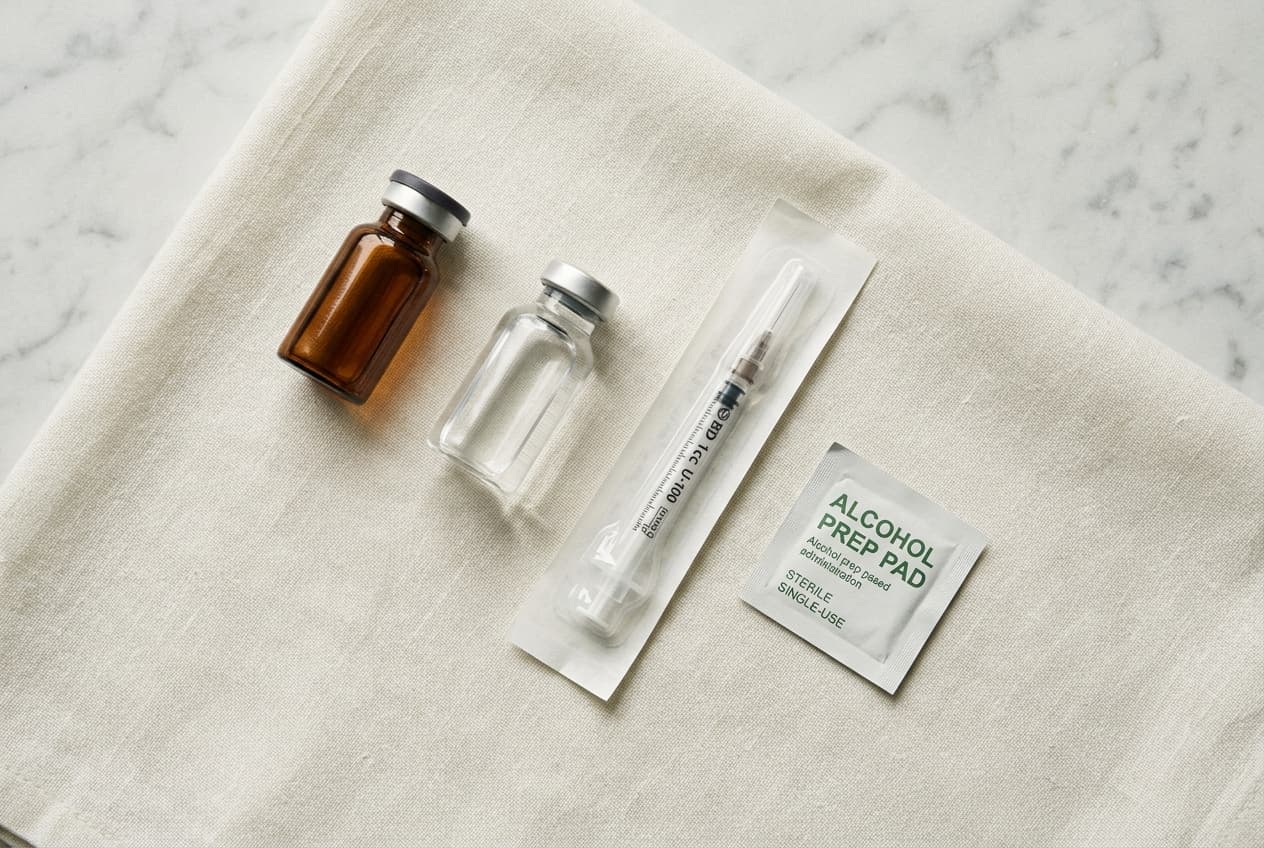
A 10 mg vial reconstituted with 1 ml bacteriostatic water gives 10 mg/ml. A 1 mg dose is 0.1 ml, which is 10 units on a U-100 insulin syringe. The approved 1.75 mg dose is 0.175 ml (about 17–18 units). Subcutaneous in the abdomen or thigh, 30–45 minutes before activity. The first dose should be a 0.5 mg test shot to gauge nausea before committing to a full dose.
Open calculator pre-filledStorage after reconstitution
Refrigerate at 2–8 °C after reconstitution. Do not freeze. Light-protected. 30 days of stability at fridge temperature in BAC water. Because dosing is occasional (not daily), keep mix volumes small — reconstitute a 10 mg vial with 2 ml for 5 mg/ml and you have 5–6 doses, comfortably inside the month.
Common mistakes
Going straight to 1.75 mg on the first dose.
Better approach: Half the people who quit do so over nausea. Start at 0.5 mg as a test shot, then 1 mg as a working dose. Only push to 1.75 mg if 1 mg felt under-effective and the nausea at 1 mg was tolerable.
Dosing it like a daily medication.
Better approach: PT-141 is on-demand. The FDA label caps it at 8 doses per month, and the melanocortin system tolerates that cadence; daily use accelerates the hyperpigmentation side effect and offers no benefit.
Stacking it with sildenafil on the same night.
Better approach: Both raise blood pressure, by different mechanisms. The combination has not been studied and the additive BP effect is the most likely problem. If you've tried PDE5 inhibitors and they don't address the desire piece, switch rather than stack.
Using it for general 'mood' or 'wellness'.
Better approach: It's a sexual-function tool, not a mood drug. The melanocortin system does touch reward pathways, but the side-effect-to-benefit math only makes sense when the target is desire. Use the right tool for the job.
Real-world tips
- Take it on a light stomach but not fully empty — moderate food blunts the nausea without much effect on absorption.
- Keep an antiemetic on hand for the first one or two doses if nausea is your concern. Ondansetron 4 mg works for most people.
- Plan a 1-hour buffer between injection and intended activity. Onset is variable; some users hit the peak at 90 minutes rather than 45.
- Rotate injection sites if you're using it frequently — the hyperpigmentation is patchy and follows repeated injection at the same spot.
- Don't drive within an hour of the first dose. The combination of flushing, mild dizziness, and nausea is not a great cocktail for road awareness.
When something else is the better tool
Sildenafil / tadalafil
Use instead when: The problem is erectile function and the desire is intact. PDE5 inhibitors are cheaper, longer-evidenced, and don't make you nauseated. Save PT-141 for when desire is the missing piece.
Oxytocin
Use instead when: The issue is connection and intimacy rather than libido. Oxytocin amplifies bonding; PT-141 amplifies sexual drive. The two address different layers of the same evening.
Testosterone optimisation
Use instead when: Bloodwork shows actual hypogonadism. Treat the underlying hormonal cause rather than papering over it with an acute desire booster — and you'll often find PT-141 becomes unnecessary once T is in range.
- Does it work for men?
- Yes, off-label. The central melanocortin mechanism doesn't care about sex. The published trials were in women because that was the regulatory path Palatin took, but the men's off-label data is consistent.
- How often can I use it safely?
- The FDA label says no more than 8 doses per month and no more than 1 dose in 24 hours. That cadence is what the safety data actually covers.
- Can I take it daily as a libido tonic?
- No. The melanocortin system desensitises, the hyperpigmentation accumulates, and the BP burden adds up. Pulse it for occasions.
- Will it make my skin darker?
- Occasional use rarely produces visible pigmentation. Frequent use over months can produce darker patches on gums, lips, face, and breasts — same mechanism as melanotan, just weaker and slower.
- How long before sex should I inject?
- Forty-five minutes is the label guidance. In practice, 60–90 minutes gives a more reliable window because the onset varies more than the marketing copy suggests.