
Selank
Also known as: TP-21
A Russian tuftsin-derived heptapeptide used intranasally for anxiety without sedation. Approved domestically as an anxiolytic; the Western evidence base is thin but the user reports are consistent.
Overview
Selank was developed at the same Russian institute that produced Semax, as a synthetic stabilised analogue of tuftsin — a natural immunomodulating peptide. The pitch is an anxiolytic that doesn't sedate, doesn't impair cognition, and doesn't produce dependence. The published mechanism touches GABA-A potentiation and BDNF expression, which fits the user experience: a steadier mood floor rather than the muffled feeling you get from a benzodiazepine. It is registered in Russia for generalised anxiety disorder, and the trial dossier behind that registration is mostly in Russian journals from one network of investigators. People reach for it because the alternatives — SSRIs, benzodiazepines, gabapentinoids — all carry costs that Selank appears to skip, but "appears to" is the operative phrase: independent Phase 2-grade Western data does not exist.
Evidence quality
Domestic Russian approval for generalised anxiety disorder, supported by the Institute of Molecular Genetics group (Zozulia, Kost, and colleagues) plus published comparisons to medazepam. The Western literature is small — a handful of pharmacology papers and one or two open-label observational reports. There is no large randomised Western trial against an SSRI or benzodiazepine. The evidence floor is honest user reports plus the Russian registration dossier.
Benefits & timeline
Benefits
- Reduced background anxiety and rumination without the cognitive fog of a benzodiazepine
- Better sleep onset when the anxiety is the thing keeping you awake — fix the cause, not the symptom
- No physical dependence or withdrawal across the typical 4–6 week course
- Subjective resilience under acute stress — useful before presentations or difficult conversations
Timeline
Day 1
A faint loosening within an hour. Often dismissed as placebo on first dose.
Week 1
Background anxiety lower; the difference is clearer to people around you than to you.
Week 2–4
Sleep improves indirectly if anxiety was the limiting factor.
Week 6
Some users feel the effect dulling — cycle off.
Off-cycle
Two weeks off. Effects often persist for some of the off period; this is normal.
Dosage protocols
Advanced
1000 mcg
twice daily intranasal
Beginner
250 mcg
once daily intranasal
Standard
500 mcg
twice daily intranasal
Titration & adjustment
Start at 250 mcg intranasally once daily. After 1 week, increase to 500 mcg twice daily if anxiolytic effect is desired. Maximum 1000 mcg twice daily. Selank is non-sedating, so timing is flexible; many users dose pre-stressful event. Cycle off for 2 weeks every 6 weeks.
Injection timing

Time of day is flexible — Selank does not affect sleep. Most users dose it in the morning or pre-stressful event. Can be combined with Semax (one drop each in the same nostril, 5 minutes apart).
Side effects & contraindications

- mildNasal irritation, especially in the first week.
- mildSlight drowsiness at the upper end of the dose range. Lower the dose rather than push through.
- mildOccasional vivid dreams.
- moderateNo long-term Western safety data. The Russian registration covers years of clinical use, but independent replication of the safety profile is limited.
Contraindications
- Pregnancy and breastfeeding
- Severe depression as a primary diagnosis — Selank is not an antidepressant and treating moderate-to-severe depression with it can delay proper care
- Concurrent benzodiazepine or opioid use at sedating doses — the drowsiness is additive in a way that matters
- Acute psychotic episode
Reconstitution & injection
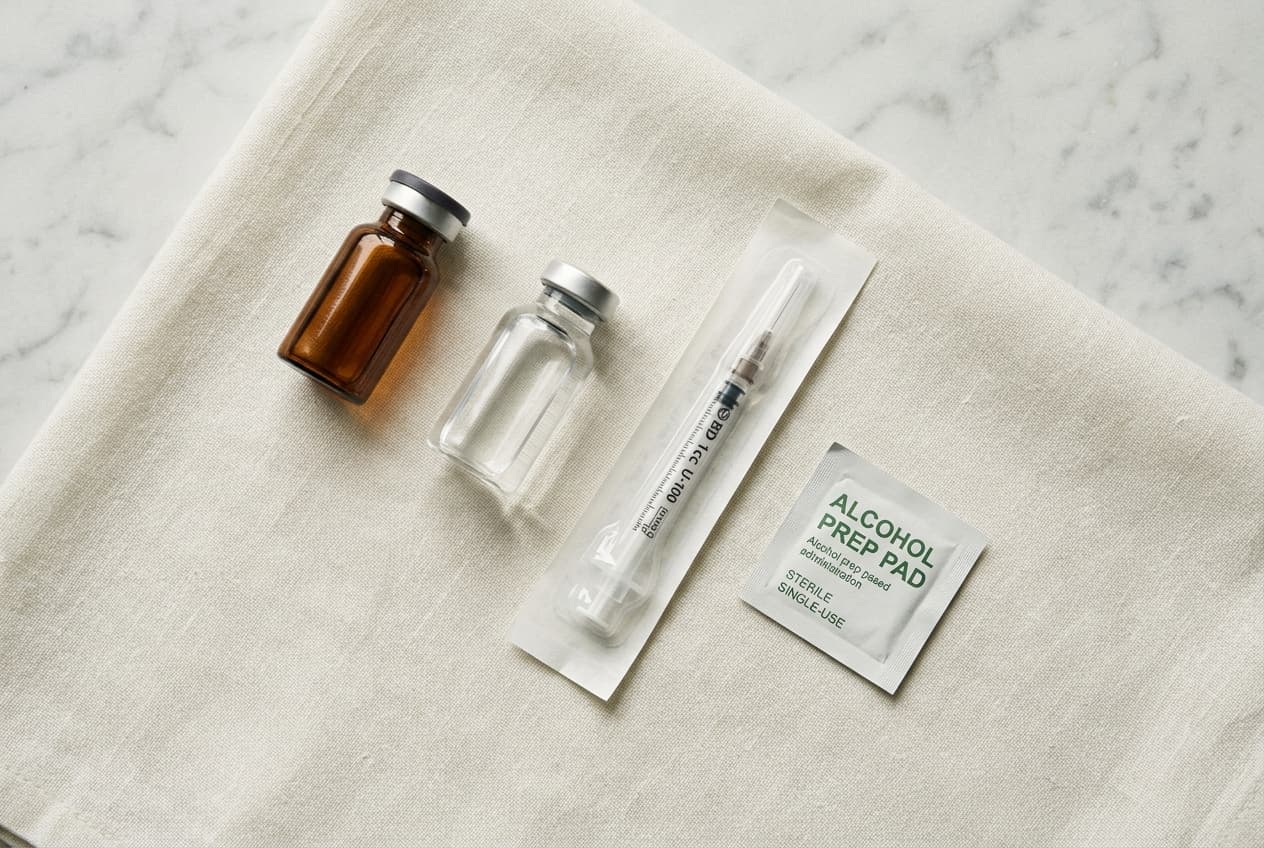
Selank is most commonly sold as a 0.15% nasal spray, ready to use. From lyophilised powder: a 5 mg vial with 2 ml bacteriostatic water gives 2.5 mg/ml. One drop from a standard nasal dropper delivers about 125 mcg, so two drops per nostril is roughly 500 mcg. Subcutaneous injection works at the same total dose and is sometimes preferred by users with chronically inflamed nasal passages, but the intranasal route is what the Russian trials used.
Open calculator pre-filledStorage after reconstitution
Same handling as Semax. Refrigerate at 2–8 °C, light-protected, 30 days of stability after reconstitution. Do not freeze. Saline is the preferred vehicle for intranasal use; BAC water is fine for subcutaneous.
Common mistakes
Using Selank as a benzodiazepine substitute for acute panic.
Better approach: Selank does not work on a benzodiazepine timescale. It will not abort a panic attack. Use it as a steady-state anxiolytic over weeks, and keep a separate clinician-prescribed plan for acute episodes.
Stopping abruptly because it does not feel like much.
Better approach: The subjective effect is small day-to-day and obvious week-to-week. Run a full 4-week cycle before judging. People who use it for two days and quit have not given the BDNF-related slower component time to develop.
Stacking it with high-dose Semax expecting more of everything.
Better approach: The pair complements rather than amplifies. Semax in the morning at the standard 250–500 mcg, Selank as needed for the anxiety side. Doubling both doses tends to produce headaches and drowsiness, not better cognition.
Treating diagnosed anxiety disorder as a grey-market peptide problem.
Better approach: If you have a clinical diagnosis with functional impairment, the evidence base for SSRIs and CBT is incomparably stronger. Selank can be useful adjunctively; it should not be the primary intervention for someone whose anxiety is meaningfully limiting their life.
Real-world tips
- Dose before the stressor when you can — a morning dose on a presentation day is more useful than an afternoon dose after the cortisol has already spiked.
- Track sleep and a simple 1–10 anxiety score nightly. The objective trend is more honest than how you feel on any given day.
- If the nasal route gives you persistent irritation, switch to subcutaneous at the same total daily dose rather than escalating the spray.
- Keep the bottle in the fridge. Room temperature is fine for several days of travel but degrades the peptide on a longer timeline.
- Do not pair with alcohol expecting a calming synergy. Alcohol blunts the BDNF effect over time and you lose the benefit you are paying for.
When something else is the better tool
SSRIs
Use instead when: The anxiety is severe, chronic, and clinically diagnosed. SSRIs have decades of trial data, prescribing support, and a clear withdrawal-management framework. Selank is the wrong primary tool here.
Semax
Use instead when: The bigger problem is attention rather than anxiety. Semax does focus; Selank does mood floor. They are not interchangeable, which is why pairing them is common.
Behavioural tools (CBT, sleep, training)
Use instead when: You have not yet done the structural work. A peptide does not fix a chronic sleep debt or an avoidant coping pattern. Run the boring interventions first; layer Selank if a measurable residual remains.
- Will it make me drowsy at work?
- At the standard 250–500 mcg per dose, no. At 1000 mcg twice daily, some users get a faint heaviness that goes away by lowering the dose. The whole point of Selank is the absence of sedation; if you feel sedated, you are above your useful dose.
- Can I take it only on stressful days?
- Yes. The acute calming component shows up within an hour, even though the bigger steady-state benefit develops over weeks. Many users dose only on demand and report a useful effect.
- Is it really non-addictive?
- There are no published cases of physical dependence or withdrawal at standard doses across the available trial duration. That is not the same as proof of zero risk over decades, but it is a different category from benzodiazepines.
- Spray or injection?
- Intranasal is the standard form and what the trials used. Subcutaneous works at the same dose and is reasonable if the spray bothers your nose.
- Does it work for social anxiety specifically?
- User reports lean yes, and the small published anxiety trials did not screen specifically for social subtype. The mechanism is broad enough that distinguishing subtypes probably doesn't matter much in practice.