
Semax
Also known as: ACTH(4-7) analogue
A Russian-developed heptapeptide based on a fragment of ACTH(4-10). Used intranasally as a focus and neuroprotection tool — registered in Russia, almost unknown in Western clinical practice.
Overview
Semax came out of the Russian Academy of Medical Sciences in the 1980s as a non-hormonal stub of adrenocorticotropic hormone, kept just long enough to retain neurotrophic activity but short enough to lose the stress-axis effects. It is registered domestically for stroke recovery and certain attention disorders, and the dosing form is a nasal drop that gets across the cribriform plate within minutes. The mechanism story centres on BDNF upregulation and modulation of dopamine and serotonin tone, which lines up with how users describe the effect: a quiet lift in focus and frustration tolerance rather than a stimulant push. The catch is that nearly all the published trials are in Russian journals from a handful of affiliated research groups, and the Western literature is thin enough that calling this anything other than an interesting nootropic with national regulatory approval would be overstating the evidence.
Evidence quality
Approved in Russia for stroke recovery, transient ischaemic attack, and cognitive impairment based on domestic trials, mostly from the Institute of Molecular Genetics and affiliated groups (Myasoedov, Levitskaya, and colleagues). The Western peer-reviewed literature includes a handful of small studies and reviews, but no Phase 3 trials outside the Russian registration pathway. Treat the focus and mood evidence as limited-human; treat the neuroprotection story as preclinical-leaning with clinical signal.
Benefits & timeline
Benefits
- Cleaner sustained attention without the jitter or comedown of stimulants
- Better frustration tolerance on cognitively heavy days — code review, long writing sessions, exam prep
- Mild mood lift that tends to show up by the end of week one rather than on day one
- Neuroprotective signal in animal stroke and ischaemia models that has informed the Russian clinical indication
Timeline
Day 1
A subtle focus boost 30–60 minutes after dosing. Easy to dismiss as placebo on the first day.
Week 1
The lift settles into the background — you notice you got through the work, not that you were on something.
Week 2–4
Mood floor lifts a notch. Users report less reactivity to small annoyances.
Week 6
Plateau. Some users feel the effect dulling — that is the cue to cycle off.
Off-cycle
Two weeks off lets receptor tone reset. Most people find the next cycle feels as strong as the first.
Dosage protocols
Advanced
1000 mcg
twice daily intranasal
Beginner
250 mcg
once daily intranasal
Standard
500 mcg
twice daily intranasal
Titration & adjustment
Start at 250 mcg intranasally once daily in the morning. After 1 week, increase to 500 mcg twice daily (morning + early afternoon) if focus benefits are noticeable. Maximum 1000 mcg twice daily. Never dose after 4 PM — Semax can disrupt sleep. Cycle off for 2 weeks every 6 weeks.
Injection timing

Morning intranasal, ideally on waking. If splitting AM + PM, the second dose must be before 4 PM — Semax can disrupt sleep. Drop 1 drop per nostril, tilt head back briefly to keep the dose in the upper nasal cavity.
Side effects & contraindications

- mildNasal irritation or a faint burn for a few seconds after dosing. Worse if the nasal mucosa is already dry.
- mildHeadache, usually only at doses above 1000 mcg or with afternoon dosing.
- mildSleep disruption if dosed past mid-afternoon.
- moderateNo long-term Western safety data. The Russian registration covers decades of use, but independent replication of the safety record outside that system is limited.
Contraindications
- Pregnancy and breastfeeding — no controlled data, central neuropeptide activity
- Active psychosis or unstable bipolar disorder — dopaminergic modulation is the wrong direction here
- Uncontrolled hypertension — caution is conventional rather than evidence-based, but the labelling carries it
- Concurrent stimulant therapy at high doses — the additive effect on focus can become uncomfortable
Reconstitution & injection
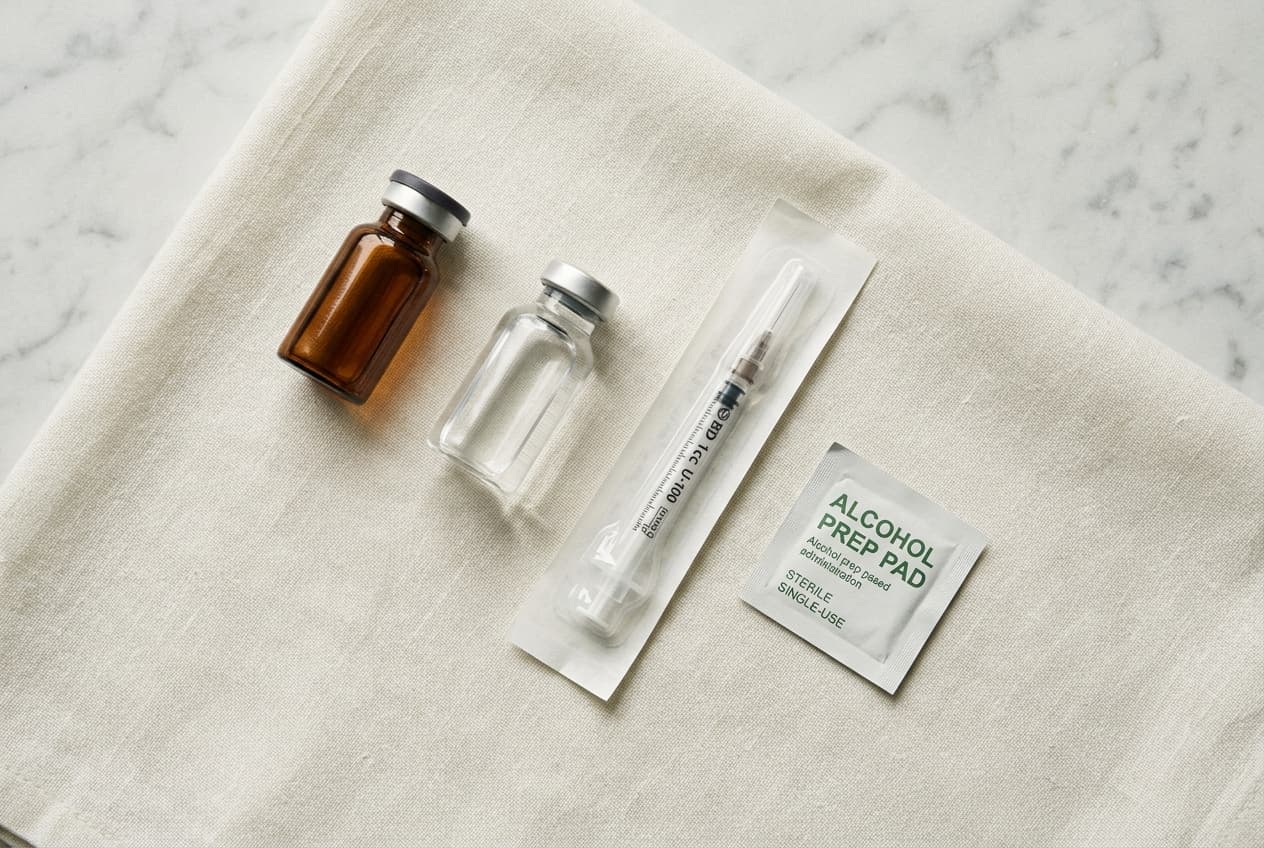
Most users source Semax as a pre-mixed 0.1% or 1% nasal spray, which is the easiest form. From lyophilised powder: a 5 mg vial with 2 ml bacteriostatic water gives 2.5 mg/ml. One drop from a standard 0.05 ml nasal dropper delivers about 125 mcg, so two drops per nostril lands at roughly 500 mcg. Dose in the morning, and if you split the daily total, dose the second half no later than early afternoon.
Open calculator pre-filledStorage after reconstitution
Intranasal spray bottles: refrigerate at 2–8 °C after first use. Light-protect. Stable 30 days at fridge temperature in saline-based nasal vehicle, or 30 days in BAC water if reconstituting from lyophilised powder. Do not freeze the spray bottle — the pump mechanism can crack. If you reconstituted in BAC water but use it intranasally, the benzyl alcohol can sting slightly; use saline if you find it irritating.
Common mistakes
Dosing it like a stimulant and expecting a noticeable hit on day one.
Better approach: Semax does not feel like caffeine or modafinil on a first dose. Run a full week before deciding whether it is doing anything; the effect tends to compound rather than spike. If you are looking for an acute push, you have the wrong tool.
Dosing late in the day to get a second focus window.
Better approach: Even a 500 mcg dose at 5 PM can push sleep onset out an hour and lighten sleep depth. Keep both daily doses before 2 PM. If you need a late-day focus tool, that is a workflow problem, not a dosing problem.
Running it indefinitely without cycling.
Better approach: The subjective effect dulls after about six weeks of continuous use. Two weeks off restores it cleanly. People who keep escalating the dose to chase the original lift usually end up with the headaches and worse sleep, not more focus.
Buying Semax powder and dissolving it in tap water for the spray bottle.
Better approach: Use bacteriostatic water from a sterile source. The peptide is stable in the fridge for several weeks at 2.5 mg/ml; tap water introduces both contamination and pH variability that degrades the peptide faster.
Real-world tips
- Prime the dropper before the first dose of a new bottle — the first squeeze often delivers air rather than liquid.
- Tilt the head slightly back and breathe in gently after dosing. Don't sniff hard — you will send the drop down the back of the throat and waste most of it.
- Keep a simple focus log for the first two weeks. Subjective drift is huge with nootropics and a one-line evening note tells you more than memory.
- If your nose is congested, the drug isn't getting through. Use saline first, wait ten minutes, then dose.
- Store the bottle upright in the fridge between uses. Room-temperature stability is fine for a few days of travel.
When something else is the better tool
Modafinil
Use instead when: You need an acute, same-day push for a long deadline or a shift. Modafinil hits harder, lasts longer, and has Western RCT data; Semax is the calmer, more sustainable daily option.
Selank
Use instead when: The problem is anxiety and frustration tolerance, not attention. Selank does what Semax does for mood without the focus push — and the two are commonly paired rather than treated as substitutes.
Boring fundamentals (sleep, caffeine timing, training)
Use instead when: Your baseline is poor. Semax on six hours of sleep is barely noticeable. Fix sleep and exercise first; the peptide layers cleanly on top, not underneath.
- How fast should I feel something?
- Within an hour of the first dose, most users notice a small, almost-not-there focus shift. If you are expecting a stimulant kick, you will dismiss it. The more reliable read is comparing the end of week one to the week before you started.
- Spray or injectable?
- Intranasal is the standard form and what every Russian trial used. Subcutaneous works but offers no clear advantage and bypasses the direct nose-to-brain route that is part of the rationale for using Semax in the first place.
- Can I dose only on workdays?
- Yes — many users skip weekends, which doubles as a built-in mini-cycle. The peptide does not require steady-state levels to work.
- Is the Russian approval meaningful for me?
- It means there is a longer real-world safety record than the Western literature shows, which is reassuring. It does not mean a Western regulator would approve it on the same dossier — the evidence base is not what the FDA or EMA would expect for a new CNS drug.
- Does it stack with Selank?
- Yes, and that is the most common combination. Semax in the morning for focus, Selank later if anxiety is the bigger problem. They do not compete mechanistically.