
VIP (Vasoactive Intestinal Peptide)
Also known as: Vasoactive Intestinal Peptide
A 28-amino-acid neuropeptide repurposed intranasally for chronic inflammatory response syndrome under the Shoemaker protocol. The clinical evidence is largely from a single practitioner network.
Overview
VIP is a real endogenous neuropeptide with broad biology — vasodilation, immune modulation, circadian signalling — but the reason it shows up in peptide protocols at all is the Shoemaker CIRS framework. Ritchie Shoemaker and a small network of trained practitioners use intranasal VIP as the last step in a multi-stage protocol for biotoxin illness, after MARCoNS clearance, antigen avoidance, and inflammatory marker stabilisation. The published clinical literature outside that network is thin: VIP has been studied in pulmonary arterial hypertension and a handful of other contexts, but its use in CIRS rests on a particular clinical model that has not been validated by large independent trials. Users who fit the model often describe it as the step that unlocked recovery they could not otherwise reach; users outside the model report inconsistent results. The honest framing is that VIP is a clinically used tool with a small dedicated practitioner base and a research evidence floor that has not caught up.
Evidence quality
The CIRS application is based on Shoemaker's clinical case series and a small body of biomarker-focused publications from the same network. There are no large independent randomised trials in CIRS. Outside CIRS, VIP has been studied in pulmonary hypertension and inflammatory lung disease with mixed results. Honest read: a clinically used compound with a defined practitioner protocol and a thin formal evidence base.
Benefits & timeline
Benefits
- Reduction of inflammatory and complement markers in CIRS patients who have already completed the upstream steps of the Shoemaker protocol
- Possible improvement in exercise capacity and post-exertional malaise in the same patient group
- Subjective improvements in sleep, mood, and cognitive clarity once inflammation drops
- Useful endpoint marker — patients who respond often see VCS (visual contrast sensitivity) normalise alongside symptom relief
Timeline
Week 1–2
Inflammatory markers may start to move; subjective changes are usually small here.
Week 4–6
Meaningful symptom relief in responders. Non-responders should be re-evaluated for missed upstream steps.
Week 8–12
Stable improvement or clear plateau. Decision point for continuation, taper, or stop.
Maintenance
Long-term low-dose maintenance in some practitioner protocols; not all users continue past initial recovery.
Dosage protocols

Advanced
200 mcg
twice daily intranasal
Beginner
50 mcg
once daily intranasal
Standard
100 mcg
twice daily intranasal
Titration & adjustment
Used in the Shoemaker protocol (mould/biotoxin recovery). Standard starting dose: 50 mcg intranasally per spray, 1 spray each nostril, up to 4 times daily. Pre-treatment requires confirming MARCoNS-negative and stable VCS — outside of that framework, dosing is empirical. Escalate slowly and stop if hypotension or persistent flushing occurs.
Injection timing

Intranasal, 4 times daily evenly spaced (every 4 hours during waking). Tilt the head back to keep the spray in the upper nasal cavity. Avoid eating within 15 minutes after spraying.
Side effects & contraindications

- mildFlushing, often noticeable in the first few sprays and fading over days.
- mildNasal irritation from frequent dosing — VIP is given up to four times daily, which the nasal mucosa notices.
- moderateHypotension, especially with concurrent antihypertensive medication or in patients with low baseline blood pressure. The vasodilatory effect is real and the name is not metaphorical.
- moderateLong-term human safety data outside the CIRS context is limited. The Shoemaker network has years of patient experience; independent replication is sparse.
Contraindications
- Pregnancy and breastfeeding
- Severe hypotension or orthostatic intolerance — VIP will make this worse
- Carcinoid syndrome — VIP can drive symptomatic exacerbation
- Unmanaged MARCoNS colonisation in the CIRS framework — using VIP before clearing this is the Shoemaker-defined contraindication and produces poor outcomes
Reconstitution & injection
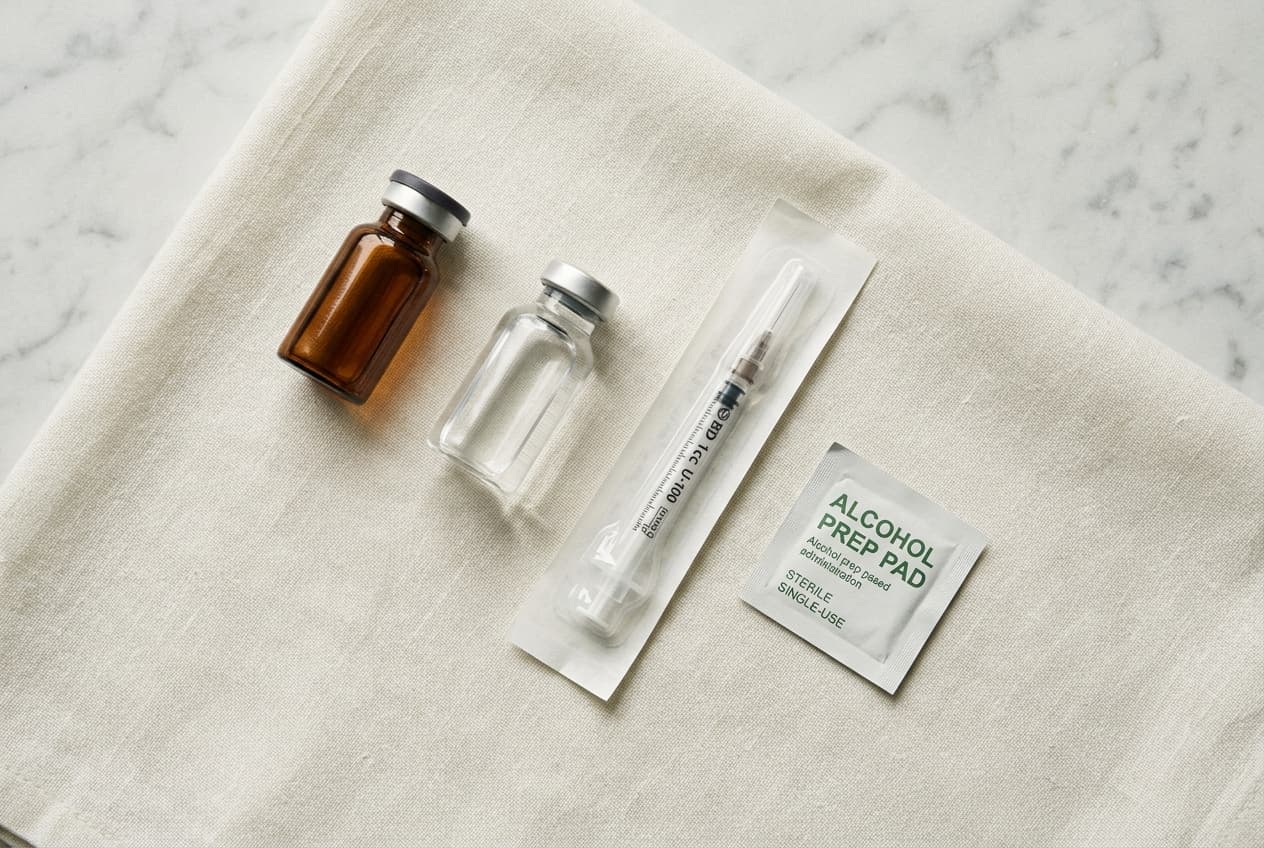
A 10 mg vial with 5 ml bacteriostatic water gives 2 mg/ml. The standard intranasal dose is 50 mcg per spray (1 spray each nostril), up to 4 times daily. Dosing is often handled by a compounding pharmacy that pre-fills metered nasal spray bottles to the practitioner's spec; if you are reconstituting yourself, a metered atomiser delivering 100 microlitres per actuation at 0.5 mg/ml gives the 50 mcg dose. Refrigerate the spray bottle between uses.
Open calculator pre-filledStorage after reconstitution

Refrigerate at 2–8 °C immediately after reconstitution. Do not freeze. Light-protected. VIP is notoriously unstable in solution — realistic shelf life is 7–14 days at fridge temperature. Most VIP protocols use intranasal delivery from a freshly reconstituted batch made every 1–2 weeks. Do not stretch a single mix beyond 2 weeks.
Common mistakes
Starting VIP without doing the upstream Shoemaker steps.
Better approach: The protocol is sequential for a reason — MARCoNS clearance, antigen avoidance, and stabilisation of TGF-beta, MMP-9, and C4a come before VIP. Skipping ahead because VIP looks like the interesting part typically produces flares and no recovery. Either commit to the framework with a trained clinician or pick a different tool.
Using VIP for general inflammation or fatigue without a CIRS workup.
Better approach: VIP is not a generic anti-inflammatory peptide. If you do not have the CIRS profile, the user reports are inconsistent and the side-effect cost (flushing, hypotension) outweighs the upside. Investigate the actual cause of the inflammation first.
Continuing despite worsening hypotension.
Better approach: VIP is a vasodilator. If you are getting lightheaded on standing, that is the peptide, not a healing crisis. Lower the dose or stop and discuss with the prescribing clinician. Pushing through is not the right move.
Self-reconstituting and dosing without metered spray equipment.
Better approach: Free-dropping VIP from a dropper produces wildly variable dosing. A metered nasal atomiser is not optional — it is the difference between a 50 mcg dose and a 200 mcg dose, and VIP's hypotension risk makes that range matter.
Real-world tips
- Tilt the head slightly back and breathe in gently. Forceful sniffing wastes the spray.
- Avoid eating for 15 minutes after a spray — chewing motion can clear the nasal cavity faster than you want.
- Track blood pressure weekly during the first month. The hypotensive effect is dose-related and individual.
- Coordinate with a Shoemaker-trained clinician if you are working through CIRS — the protocol involves lab markers (TGF-beta, MMP-9, C4a, VEGF, VCS) that you should be tracking, not just symptoms.
- Refrigerate the bottle. Room-temperature stability is shorter than for most peptides because of the larger molecule.
When something else is the better tool
Generic anti-inflammatory peptides (BPC-157, KPV)
Use instead when: Your problem is local or systemic inflammation without the CIRS profile. These are better-evidenced for general inflammation and have less hypotensive risk. VIP is the wrong tool outside its niche.
Standard CIRS pharmacology (cholestyramine, antifungals, low-amylose diet)
Use instead when: You are early in a CIRS workup. The Shoemaker protocol places VIP late by design. Doing the earlier steps first is not optional from inside that framework.
Investigate other diagnoses
Use instead when: You suspect CIRS but have not been formally evaluated. Many fatigue + cognitive symptom patterns look like CIRS and are something else entirely. Work with a clinician who can rule in or out the diagnosis before committing to VIP.
- Do I need to be in the Shoemaker protocol to use this?
- Practically, yes. Outside that framework the evidence is weak and the side-effect cost is real. If you are not working with a CIRS-trained clinician, there are better-evidenced and safer tools for the symptoms VIP claims to address.
- How fast should I feel something?
- Slowly. Inflammatory markers may move in the first 2 weeks; symptomatic recovery typically lands at 4–8 weeks if it is going to land. Faster responses sometimes mean you are responding to something else in the protocol.
- Why intranasal and not injection?
- Intranasal targets the central nervous system via the olfactory route, which is the rationale in CIRS where neuroinflammation is part of the model. Subcutaneous VIP exists but is not the standard form for this indication.
- Is the hypotension dangerous?
- It is the most common reason to stop. For most users it is mild and self-resolving; for users on antihypertensives or with already-low blood pressure, it can be significant. Track it.
- What is MARCoNS and why does it matter?
- Multiply Antibiotic Resistant Coagulase Negative Staphylococci — a nasal biofilm organism that the Shoemaker framework identifies as a barrier to VIP working. Clearing it is the prerequisite step. This level of protocol-specific detail is why a trained clinician is genuinely useful here.